
Manaslu Circuit Trek Weather by Month: Temperature and Best Time to Visit
15th Oct, 2026
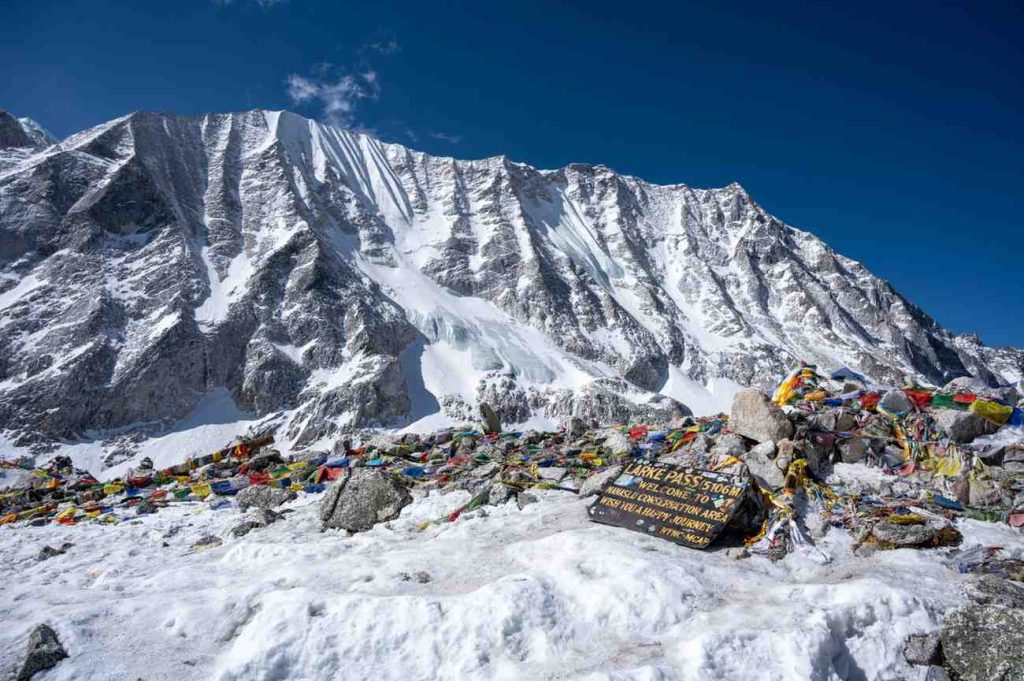
The weather decides almost everything on the Manaslu Circuit: how clear your views are, how safe the trail feels and whether you can cross Larkya La at all. This is a remote, restricted-area trek around the world’s 8th highest mountain, Mt. Manaslu (8,163 m). It has no easy exits, so choosing the right month matters more than on busier routes.
Table of Contents
This guide covers temperature by altitude, what each month is really like on the trail, and which season suits your trekking style. If you only want the short answer, start with the section below.
Quick Answer: What Is the Best Time for the Manaslu Circuit Trek?
The best time to trek the Manaslu Circuit is autumn (September to November) and spring (March to May). October is the single best month, with the clearest skies, the most stable weather and the best chance of a smooth Larkya La crossing.
| Season | Months | Trek Rating | Main Reason |
|---|---|---|---|
| Autumn | Sep – Nov | Excellent | Crisp, clear skies and stable weather |
| Spring | Mar – May | Excellent | Rhododendrons, warm days, fewer trekkers |
| Monsoon | Jun – Aug | Not recommended | Heavy rain, leeches and landslide risk |
| Winter | Dec – Feb | Difficult | Heavy snow and a risk of Larkya La closing |
Our local guides run departures in both main seasons. You can see the current dates on the Short Manaslu Circuit Trek – 11 Days page, which has group-joining departures from October 2026 through May 2027.
Understanding Manaslu’s Weather: Why Altitude Changes Everything
The trail climbs from subtropical river gorges at about 900 m to the icy Larkya La Pass at 5,106 m, then drops again. In a single week you can walk through T-shirt weather, cold alpine mornings and a freezing pre-dawn start.
As a rule of thumb, temperature drops about 6°C for every 1,000 m you climb. These are the three zones you will pass through:
- Lower valley (Machha Khola, Jagat, Deng, about 900–1,800 m): warm, humid and green.
- Mid-altitude (Namrung, Lho, Samagaon, about 2,600–3,500 m): cool days and cold nights.
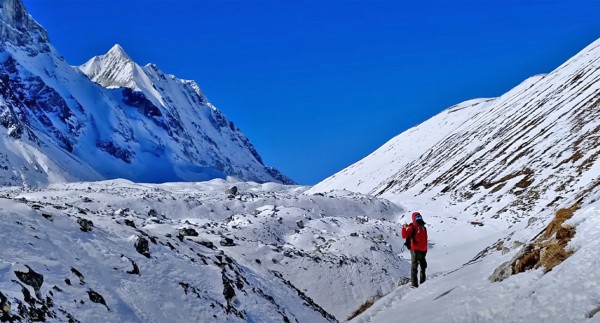
- High zone (Samdo, Dharmasala, Larkya La, about 3,860–5,106 m): cold, windy and often below freezing.
The monsoon also behaves differently here than in Kathmandu. The lower Budhi Gandaki valley takes the brunt of the rain, while the upper valleys near Samagaon sit partly in a rain shadow.
Manaslu Circuit Trek Temperature by Altitude (Approximate Ranges)
These are typical ranges for the two main trekking seasons. Mountain weather varies year to year, so treat them as planning guides rather than guarantees.
| Altitude Zone | Autumn Day | Autumn Night | Spring Day | Spring Night |
|---|---|---|---|---|
| Machha Khola – Deng (900–1,800 m) | 20–27°C | 12–17°C | 20–28°C | 10–16°C |
| Namrung – Samagaon (2,630–3,530 m) | 8–16°C | -2 to 5°C | 8–17°C | -3 to 5°C |
| Samdo – Dharmasala (3,860–4,460 m) | 2–9°C | -10 to -3°C | 0–10°C | -12 to -4°C |
| Larkya La Pass (5,106 m) | -8 to 3°C | -15 to -8°C | -8 to 4°C | -15 to -8°C |
Wind chill matters. On pass day the wind can make it feel 10°C or more colder than the air temperature, which is why a proper layering system and down jacket are essential.
Manaslu Circuit Trek Weather by Month
January: Cold, Clear and Risky
January is the heart of winter. Days in the lower valley can be pleasant, but the upper trail is frozen and snow-covered. Larkya La is often heavily snowed in, and some teahouses at higher altitudes close for the season.
- Lower valley: about 12–20°C by day
- Samagaon: around 0–7°C by day, well below freezing at night
- Larkya La: extremely cold, with possible closure
Verdict: Only for highly experienced winter trekkers with flexible schedules.
February: Still Winter, Slowly Easing
Snow remains deep on the high sections, but skies are often crystal clear. Late February sometimes brings improving conditions, though pass crossings remain unpredictable.
Verdict: Challenging. Not recommended for first-time high-altitude trekkers.
March: Spring Begins
March is the start of the spring season. Lower elevations warm up and mornings are bright, while snow still lingers above Samagaon. Pass conditions depend on the winter’s snowfall.
- Lower valley: warm and comfortable
- Upper villages: cold nights, with snow patches on the trail
- Larkya La: often crossable by late March, but check conditions with your guide
Verdict: Good for trekkers who enjoy cooler conditions and quiet trails.
April: Rhododendron Season
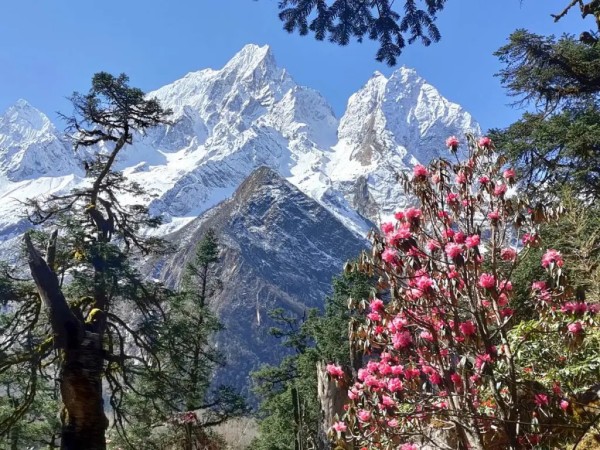
April is one of the most beautiful months on Manaslu. The lower forests bloom with rhododendrons, the days are warm and the high peaks stand sharp against blue skies. Afternoon haze or light cloud can appear at lower elevations, but mornings are typically clear.
- Lower valley: about 20–28°C
- Samagaon: mild days, cold nights
- Larkya La: generally stable by mid-to-late April
Verdict: Excellent. A top pick for color, wildlife and fewer crowds than autumn.
May: Warm Days, Early Pre-Monsoon Haze
May brings warmer temperatures and longer days. Views can turn hazy in the afternoons, and clouds build earlier as the monsoon approaches. Early May is usually still very good.
Verdict: Very good, especially in the first half of the month.
June: Monsoon Arrives
Heavy rain begins, trails turn muddy and leeches appear in the lower sections. Landslides can block the road to Machha Khola and sections of the trail. Views are often hidden behind cloud.
Verdict: Not recommended for the standard circuit.
July: Peak Monsoon
July is the wettest month. Landslide risk is high, rivers swell and transport can be unreliable. Safety and logistics are the main concerns, with scenery a distant second.
Verdict: Avoid.
August: Monsoon Continues
Rain remains heavy and trail conditions stay unpredictable. Late August sometimes shows early signs of clearing, but this is not reliable.
Verdict: Avoid unless you are specifically seeking a rain-shadow adventure with an experienced local team.
September: Post-Monsoon Reset
September is a transition month. The landscape is lush and green, rivers are full and waterfalls are spectacular. Showers can still occur early in the month, but conditions improve steadily and skies clear toward the end.
Verdict: Good. Choose the second half of the month for better visibility.
October: The Best Month
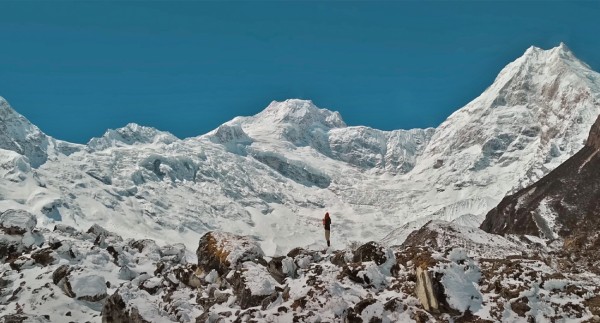
October is the favorite for good reason. Skies are crisp and clear, daytime temperatures are comfortable, trails are dry and the pass crossing is the most predictable of the year. Mt. Manaslu, Himalchuli, Ngadi Chuli and Ganesh Himal show at their sharpest.
- Lower valley: warm and dry
- Samagaon: cool, bright days
- Larkya La: the most reliable window of the year
Verdict: Excellent. It’s busier than other months, so book early.
We run several group-joining departures from mid-October onward, and you can check availability on the Short Manaslu Circuit Trek page.
November: Cold, Stable and Quiet
November stays very clear and stable, with fewer trekkers on the trail. Temperatures drop noticeably, especially at night above 3,500 m. Early November is still excellent. By late November, cold becomes the main challenge.
Verdict: Excellent for early and mid-November, with colder conditions as the month ends.
December: Early Winter
Skies are clear but nights are very cold, and snowfall can appear on the high sections. Larkya La may still be crossable early in the month, depending on the season’s weather.
Verdict: Possible with proper gear and a flexible plan, but colder and riskier than autumn.
Month-by-Month Summary Chart
| Month | Weather | Larkya La | Rating |
|---|---|---|---|
| January | Very cold, snow | Often closed | Poor |
| February | Cold, snowy | Unpredictable | Poor |
| March | Cool, improving | Possible | Fair–Good |
| April | Warm, blooming | Generally open | Excellent |
| May | Warm, some haze | Open | Very good |
| June | Heavy rain | Unreliable | Avoid |
| July | Peak monsoon | Unreliable | Avoid |
| August | Heavy rain | Unreliable | Avoid |
| September | Clearing, green | Usually open | Good |
| October | Clear and stable | Best window | Excellent |
| November | Cold, clear | Open | Excellent |
| December | Very cold | Weather dependent | Fair |
Autumn vs. Spring: Which Is Better for You?
Choose autumn (Sep–Nov) if you want:
- The most stable weather and clearest mountain views
- The most reliable Larkya La crossing
- Dry trails and settled teahouse operations
Choose spring (Mar–May) if you want:
- Rhododendron forests in bloom
- Warmer lower-valley days
- Fewer trekkers on the trail than in October
Both seasons suit the Short Manaslu Circuit, a compact 11-day itinerary that covers the highlights of the full loop: Samagaon, Birendra Lake, Samdo and the Larkya La crossing. See the full day-by-day plan on the Short Manaslu Circuit Trek page.
How Weather Affects Larkya La Pass Day
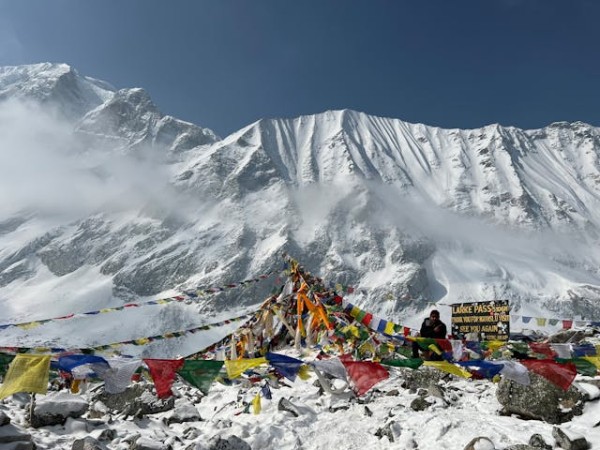
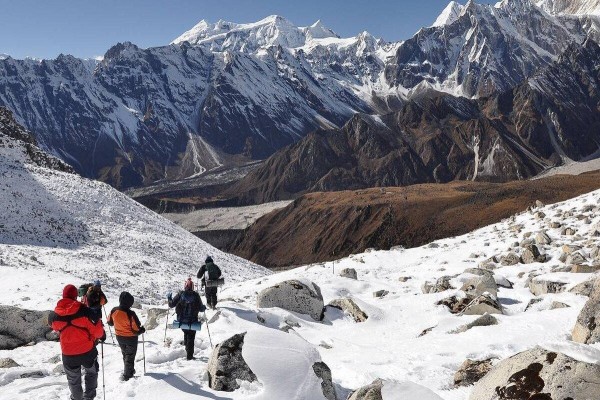
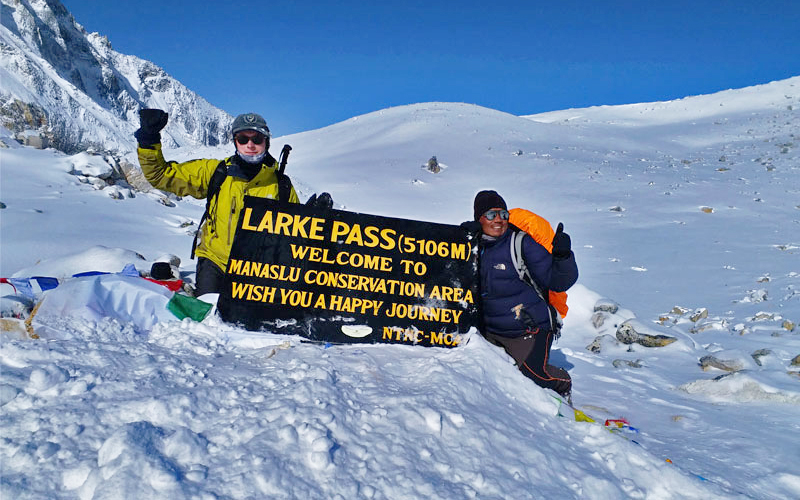
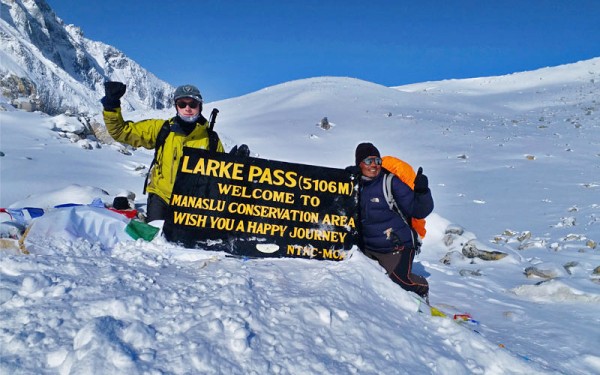
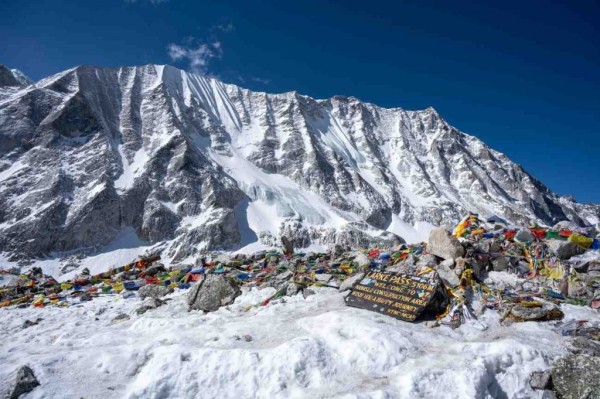
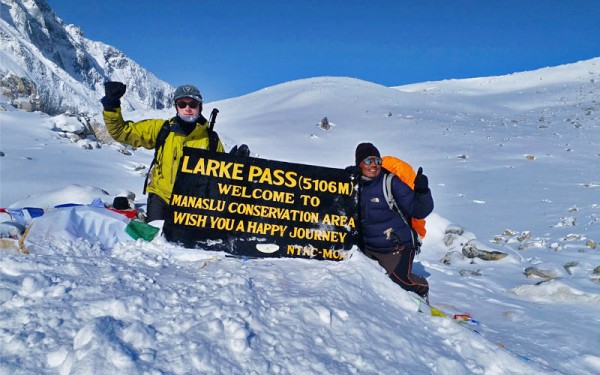
Pass day is the longest and hardest of the trek: about 8–9 hours from Dharmasala (4,460 m) over Larkya La (5,106 m) and down toward Bimthang. Weather matters most here.
- Start early. Most groups leave in the dark to cross before the afternoon wind rises.
- Expect cold. The pre-dawn start can be -10°C or lower.
- Watch the forecast with your guide. A licensed local guide will adjust the plan if snow, wind or poor visibility makes the crossing unsafe.
- Build in flexibility. If you can add a spare day, do it.
Packing for Manaslu’s Weather
Because temperatures swing from warm valleys to freezing passes, layering is everything.
Essential cold-weather items:
- A down jacket (essential above 3,000 m)
- Thermal base layers and a fleece mid-layer
- Waterproof shell jacket and trousers
- Warm gloves, a hat and a buff
- Waterproof trekking boots and wool socks
- A sleeping bag rated to about -10°C
- Trekking poles, sunglasses and SPF 50+ sunscreen
Mountain Eco Treks can supply a down sleeping bag, down jacket and duffle bag on request, so you don’t have to carry the heaviest cold-weather gear from home. A full packing checklist is on the Short Manaslu Circuit Trek page.
Altitude and Weather: Staying Safe
Cold and altitude combine to raise the risk of mountain sickness. To trek safely:
- Acclimatize properly. The itinerary includes a rest day at Samagaon (3,530 m), with a side hike to Birendra Lake.
- Hydrate well and avoid alcohol at altitude.
- Know the early symptoms of altitude sickness: headache, nausea, dizziness and poor sleep.
- Monitor oxygen levels. Our guides carry an oximeter and check oxygen saturation and pulse regularly.
- Talk to your doctor about preventative medication such as Diamox before you travel.
- Never ignore symptoms. Descending is always the safest response.
Permits and Seasonal Costs
The Manaslu region is a restricted area, so you need a Restricted Area Permit, a Manaslu Conservation Area Permit and an Annapurna Conservation Area Permit, all arranged through a registered trekking agency with a licensed guide.
Seasonal permit costs differ. According to Mountain Eco Treks’ current guidance, the Restricted Area Permit costs USD 100 for the first 7 days (September–November) and USD 75 for the first 7 days (December–August), with additional per-day fees after that. Permit rules and fees can change, so confirm current rates before booking.
Which Manaslu Itinerary Fits Your Season?
- Short Manaslu Circuit Trek (11 days): the best fit for trekkers with limited time who still want the full pass experience.
- Manaslu Circuit Trek (14 days): a more gradual pace, ideal if you want extra acclimatization.
- Tsum Valley Trek: a sacred hidden valley in the same restricted region, which can be combined with the circuit.
If you are weighing other Himalayan options, compare Manaslu with the Short Annapurna Circuit Trek, a good alternative if you want a shorter, more accessible circuit.
Frequently Asked Questions
1. What is the Short Manaslu Circuit Trek, and how is it different from the full circuit?
The Short Manaslu Circuit Trek is an 11-day version of the classic loop around Mt. Manaslu (8,163 m), the world’s 8th highest mountain. It keeps the highlights of the full route: the Budhi Gandaki gorge, Tibetan-influenced villages like Namrung, Lho, Sama Gaon and Samdo, Birendra Lake, and the Larkya La Pass crossing.
The full Manaslu Circuit Trek runs 14 days (some operators list 13 to 16). The extra days give you a gentler pace, more rest and more side trips, while the short version moves faster with fewer buffer days. The short trek suits you if:
- You have limited time but want the full pass experience.
- You are already fit and have some experience at altitude.
- You want a remote, quiet alternative to the Annapurna or Everest regions.
Route at a glance: Kathmandu → Machha Khola → Jagat → Deng → Namrung → Sama Gaon (rest day) → Samdo → Dharmasala → Larkya La → Bhimphedi → Tilje → Kathmandu.
2. How difficult is the trek, and who can do it?
The trek is rated moderate to challenging. No technical climbing is needed, but it is physically demanding for these reasons:
- Long days: Most trekking days run 5 to 8 hours, and pass day runs 8 to 9 hours.
- Altitude: You sleep as high as 4,460 m at Dharmasala and cross Larkya La at 5,106 m.
- Remoteness: Facilities get more basic as you climb, and rescue takes longer than on busier routes.
Good cardiovascular fitness matters more than strength. Start training 8 to 12 weeks ahead with hiking, stair climbing, cycling or running, plus a few long days carrying a daypack. Prior experience at altitude is strongly advisable, so this is not the best choice for a first-ever high-altitude trek.
On age, the recommended minimum is 13 years, with good fitness and proper supervision.
3. What is the best time to do the Short Manaslu Circuit Trek?
The best seasons are autumn (September to November) and spring (March to May).
- October is the best single month, with clear skies, stable weather and the most predictable Larkya La crossing.
- Spring brings blooming rhododendrons, warm lower valleys and usually fewer trekkers than October.
- Monsoon (June to August) brings heavy rain, leeches and landslide risk, so it is not recommended.
- Winter (December to February) brings very cold nights and heavy snow, and the pass may close.
For a deeper breakdown by month and altitude, see the weather guide above. Group-joining departures run from October 2026 through May 2027, so you can pick dates that fit your season.
4. What permits do I need, and how much do they cost?
The Manaslu region is a restricted area, so you cannot trek it independently. You need three permits plus a local fee:
| Permit | Cost |
|---|---|
| Manaslu Restricted Area Permit (RAP), Sep–Nov | USD 100 for the first 7 days, then USD 15 per extra day |
| Manaslu Restricted Area Permit (RAP), Dec–Aug | USD 75 for the first 7 days, then USD 10 per extra day |
| Manaslu Conservation Area Permit (MCAP) | USD 20 |
| Annapurna Conservation Area Permit (ACAP) | USD 20 |
| Local municipality entrance fee | USD 7 |
The total typically falls around USD 150 to 160 per person, depending on the season and your itinerary.
All permits must be arranged in Kathmandu through a government-registered trekking agency, and a licensed guide is legally required. Mountain Eco Treks handles the paperwork, and all required permits are included in both the Standard and Budget packages. Fees can change, so confirm current rates when you book.
5. Do I need a guide, and can I trek solo?
Yes, a licensed guide is mandatory. Permits will not be issued without a registered guide, so independent trekking is not possible in this region.
Solo travelers are welcome, though. You can book a private trek, or join a group departure (group size is 1 to 15) and share the trail with other trekkers. Your package includes:
- One government-licensed, English-speaking guide with full insurance
- Regular oxygen saturation and pulse checks with an oximeter
- A first-aid kit carried through the trek
- Porter service (one porter shared between two trekkers in the Standard Plan; available at extra cost on the Budget Plan)
6. How much does the trek cost, and what is included?
There are two packages for the 11-day trek:
| Standard Plan | Budget Plan | |
|---|---|---|
| Price | US$ 1,485 per person | US$ 1,050 per person |
| Transport | Private vehicle (Kathmandu to Machha Khola, Tilje to Kathmandu) | Public transport |
| Kathmandu hotel | 2 nights, 3-star with breakfast | Not included |
| Porter | Shared (1 porter per 2 trekkers) | Extra cost on request |
| Permits (RAP, MCAP, ACAP) | Included | Included |
| Guide, trek accommodation, 3 meals daily, water, SIM card, airport transfers, welcome dinner, taxes | Included | Included |
Not included in either plan: international flights, Nepal visa, travel insurance, personal gear, drinks, laundry and hot showers, Wi-Fi, and tips for your guide and porter.
Both packages include a free local SIM card, down sleeping bag and down jacket on request, and a welcome dinner in Kathmandu. Prices can change, so check the trip page for current rates.
7. What is the day-by-day itinerary, and where is the hardest day?
| Day | Route | Max. Elevation | Time |
|---|---|---|---|
| 1 | Drive Kathmandu → Machha Khola | 900 m | ~8 hrs drive |
| 2 | Trek to Jagat | 1,410 m | 6–7 hrs |
| 3 | Trek to Deng via Philim | 1,800 m | 6–7 hrs |
| 4 | Trek to Namrung | 2,630 m | 5–6 hrs |
| 5 | Trek to Sama Gaon via Lho | 3,530 m | 7–8 hrs |
| 6 | Acclimatization day in Sama Gaon (Birendra Lake hike) | 3,530 m | Rest/short hike |
| 7 | Trek to Samdo | 3,860 m | 4–5 hrs |
| 8 | Trek to Dharmasala (Larke Base Camp) | 4,460 m | 4–5 hrs |
| 9 | Cross Larkya La (5,106 m) to Bhimphedi | 5,106 m | 8–9 hrs |
| 10 | Trek to Tilje Village | 2,300 m | 6–7 hrs |
| 11 | Drive Tilje → Kathmandu | 1,400 m | 8–9 hrs drive |
Day 9 is the hardest. It starts well before dawn, climbs to 5,106 m in the cold, and then descends a long way. The reward is a 360° panorama including Manaslu, Annapurna II, Himlung Himal, Cheo Himal and Kang Guru.
8. How do I avoid altitude sickness?
Altitude sickness (AMS) can affect anyone, regardless of fitness. The itinerary builds in an acclimatization day at Sama Gaon (3,530 m), and these habits further lower your risk:
- Ascend gradually and don’t push the pace.
- Drink plenty of water (about 3 to 4 liters a day) and eat well, even when appetite drops.
- Avoid alcohol at altitude.
- Learn the early symptoms: headache, nausea, dizziness, fatigue and poor sleep.
- Report symptoms immediately to your guide, who checks oxygen saturation and pulse regularly.
- Ask your doctor about Diamox before you travel. It is a decision for you and your doctor, not something to start casually on the trail.
- Descend if symptoms worsen. This is the single most important rule, and your guide will make that call if needed.
Because evacuation from a remote restricted area is difficult, good travel insurance is essential (see below).
9. What should I pack, and what travel insurance do I need?
Core packing list:
- Clothing: moisture-wicking T-shirts, fleece, down jacket (essential above 3,000 m), waterproof jacket, quick-dry trousers, wool socks, gloves, hat and a buff
- Footwear: waterproof boots with ankle support, plus sandals or slippers for evenings
- Gear: 10 to 15 L daypack, trekking poles, a 2 L water bottle, headlamp with spare batteries, sunglasses (UV400), and a sleeping bag rated to about -10°C
- Health: water purification tablets or a filter, sunscreen (SPF 50+), lip balm, painkillers, anti-diarrheal medicine, bandages and personal prescriptions
- Documents: passport (valid 6+ months), Nepal visa, insurance details and passport photos
- Electronics: phone with offline maps, camera, power bank and a Nepal 2-pin adapter
You can borrow a down sleeping bag, down jacket and duffle bag on request instead of buying them.
Insurance: Travel insurance is mandatory and not included. Make sure your policy covers high-altitude trekking and emergency helicopter evacuation. The trip page lists cover to 5,000 m in one place and 5,500 m in another, so choose a policy that covers at least the pass height of 5,106 m, ideally with some margin.
10. What are the accommodation, food, communication and visa arrangements?
Accommodation: This is a fully supported teahouse trek, so you don’t need camping gear. Rooms are twin-sharing and basic but comfortable, with warm common areas. Rooms get colder and simpler at higher altitude.
Food: Expect three meals a day on the trail. Menus include dal bhat (the classic Nepali set meal), noodle soups, pasta, pancakes and, higher up, yak cheese dishes. The package also includes energy bars and seasonal fruit on trekking days, plus unlimited chlorine-treated drinking water.
Wi-Fi and phone signal: Basic Wi-Fi is available at some lower and mid-altitude teahouses for a fee. Signal becomes very limited above Sama Gaon. A free local SIM card is included in your package.
Cash: There are no ATMs on the trail. Carry enough Nepali rupees from Kathmandu, plus some USD cash, which many teahouses accept.
Visa: Most nationalities can get a Nepal visa on arrival at Tribhuvan International Airport, or apply online in advance. Current fees listed on the trip page are:
- 15 days: USD 30
- 30 days: USD 50
- 90 days: USD 125
Bring a passport valid for at least 6 months, a recent photo and cash for the fee. Indian citizens do not need a visa. Rules and fees can change, so check the official Nepal immigration website before you travel.
Booking and cancellation: A 20% non-refundable deposit secures your booking, with the balance paid on arrival. If you postpone, your deposit stays secured for future use.
Final Thoughts: Plan Around the Weather, Not Against It
Good timing turns a hard trek into a great one. If you want the safest, clearest conditions, aim for October or early November. If you prefer flowers, warmth and quieter trails, choose April. Avoid the monsoon, and treat winter as an expert-only option.
Ready to plan your trek? Explore the Short Manaslu Circuit Trek – 11 Days, pick a departure date, or contact the Mountain Eco Treks team for a custom itinerary. You can also message us on WhatsApp at +977 9803926665.
Recent From Blog

19th Apr, 2019


23rd Dec, 2018

11th Jan, 2024

14th Jan, 2024

29th Jan, 2025

11th Feb, 2025

18th Feb, 2025

25th Feb, 2025

5th Apr, 2025
23rd Dec, 2025
9th May, 2026
12th Jul, 2026

13th Aug, 2026
13th Aug, 2026
13th Aug, 2026

16th Aug, 2026
20th Aug, 2026


11th Sep, 2026
24th Sep, 2026
25th Sep, 2026
5th Oct, 2026
6th Oct, 2026
11th Oct, 2026