
Everest Base Camp Trek With Helicopter Return: Walk Up, Fly to Kathmandu (2026 Guide)
29th Jul, 2026
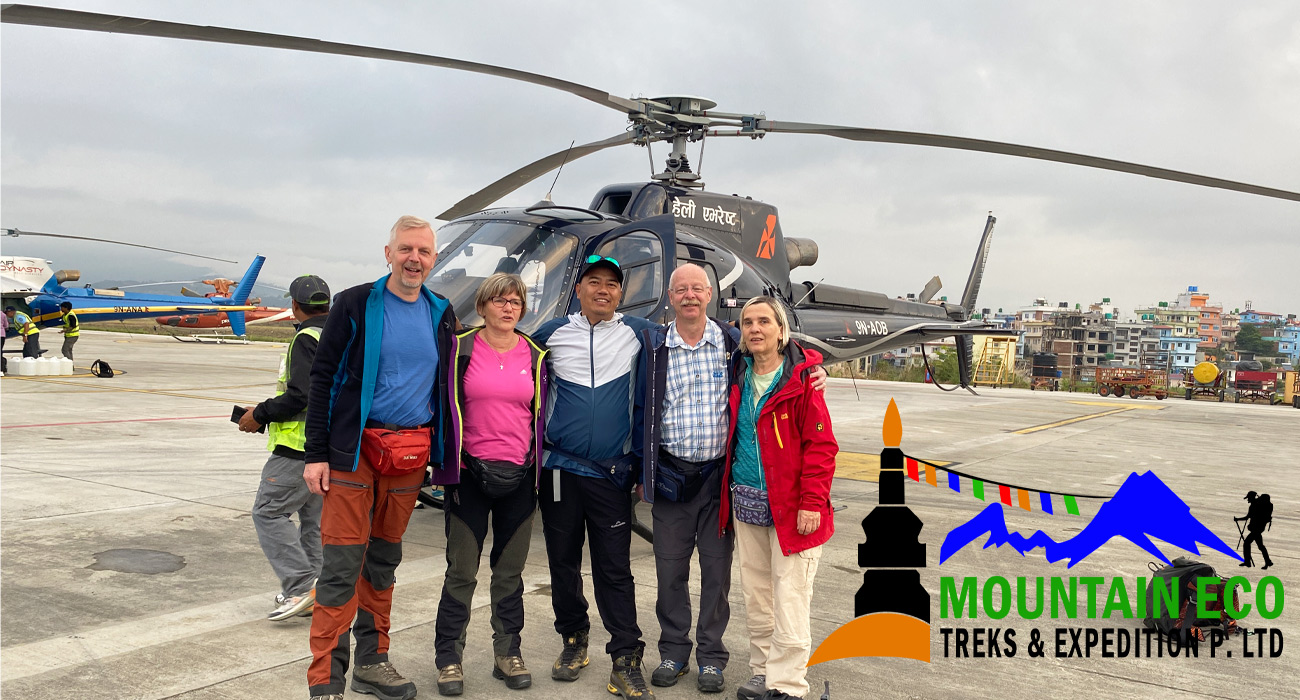
Short answer: The Everest Base Camp Trek With Helicopter Return is a 10-day trip where you hike the classic Khumbu trail from Lukla to Everest Base Camp at 5,364 m, then fly straight to Kathmandu by helicopter instead of walking back down. It cuts three to four days off the standard itinerary, spares your knees the long descent, and hands you an aerial view of the Khumbu Icefall that almost nobody on the regular trek ever gets. Packages run USD 2,295 to USD 3,999 per person.
Table of Contents
Quick Facts
| Duration | 10 days (Kathmandu to Kathmandu) |
|---|---|
| Trekking days | 8 |
| Return | Helicopter from Gorak Shep or Pheriche |
| Maximum altitude | 5,545 m (Kala Patthar) |
| Everest Base Camp | 5,364 m |
| Highest sleeping altitude | 5,164 m (Gorak Shep) |
| Walking distance | ~65 km on foot, one way |
| Total ascent | ~3,900 m cumulative |
| Average walking day | 5–7 hours |
| Helicopter flight time | ~15 min to Lukla, ~25 min Lukla to Kathmandu |
| Difficulty | Moderate to challenging |
| Best seasons | March–May, October–November |
| Group size | 2–12 (private departures available) |
| Accommodation | Teahouse lodges; upgrades available |
| Price | USD 2,295–3,999 per person |
| Permits | Sagarmatha National Park + Khumbu Pasang Lhamu |
The Part of the Trek Nobody Talks About
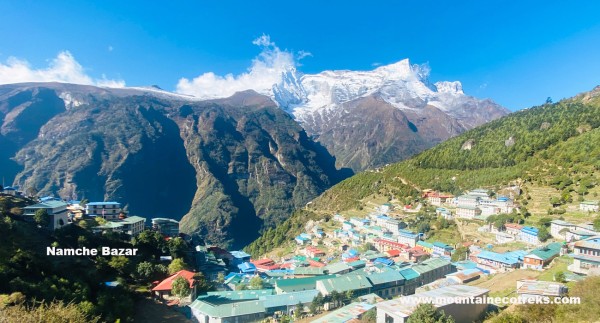
 Ask anyone who has done the classic Everest trek what they remember, and they'll tell you about the first sight of Everest through the pines above Namche Bazaar . The bells at Tengboche. The cold, thin, unbelievably clear air at Gorak Shep.
What they usually don't mention is days ten through thirteen.
Because here's the thing about walking back: you've already seen it. Your body peaked at Base Camp and now it's just tired. You're retracing eight days of trail in reverse, past the same lodges, with sore quads and a head already halfway home. It's not bad, exactly. It's just over. And you still have four days of it left.
That gap between the emotional end of the trek and the logistical end is why the Everest Base Camp Trek With Helicopter Return has quietly become the most requested Everest package in Nepal. You keep every single thing that makes the trek worth doing - the slow climb, the acclimatisation, the villages, the earning of it - and you skip the anticlimax.
You still walk to Base Camp. You just don't walk away from it.
At Mountain Eco Treks we've been running this itinerary for years, and the guide below is the one we give our own clients before they book - costs, altitude, weather risk, and the things that don't make it into most brochures.
At a Glance: Is This Trek Right for You?
| ✅ Choose this if | You have limited annual leave · Your knees don't love long descents · You're 55+ and want to limit cumulative fatigue · You want the aerial view of the Khumbu Icefall · You'd feel safer with rapid descent built into the plan |
|---|---|
| ❌ Choose the classic trek if | Budget is your main constraint · You're a photographer who wants more village time · You want maximum time in the Khumbu · Weather-delay risk would stress you out |
If you're somewhere in the middle, compare all three options: the Everest Base Camp Trek With Helicopter Return, the classic Everest Base Camp Trek, and the Everest Base Camp Luxury Trek.
What This Trek Actually Involves
It's a hybrid. The way up is 100% on foot, exactly as it has always been done. The way back is by air.
On foot (days 1–8): Lukla → Phakding → Namche Bazaar → Tengboche → Dingboche → Lobuche → Gorak Shep → Everest Base Camp, with two proper acclimatisation days built in.
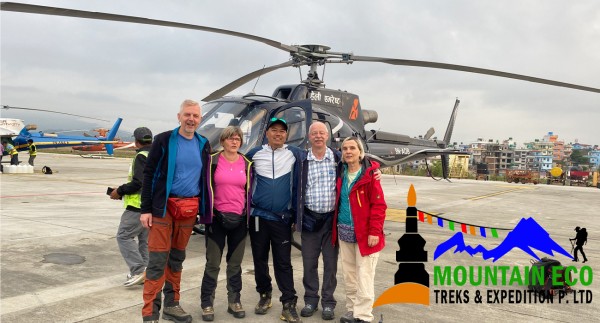
By air (day 9, early morning): After a sunrise climb up kalapatthar the helicopter lifts from Gorak Shep or Pheriche, stages through Lukla, and continues to Kathmandu.
That staging step matters. Helicopters lose lift badly in thin air - a machine that carries five people out of Lukla might only manage two at 5,100 m. So most operators run a short shuttle from the high point down to Lukla or Pheriche, then consolidate everyone into one flight to Kathmandu. If someone promises you a full cabin flying non-stop from Gorak Shep to Kathmandu, that's a red flag, not a perk.
The 10-Day Itinerary
Day 1 - Kathmandu to Lukla, trek to Phakding (2,610 m)
Walking: 3 hrs · Descent: ~200 m
You fly direct from Kathmandu to Lukla - no pre-dawn drive to Manthali, which is how most Everest packages are routed in peak season and costs you four or five hours on a bus before you've even taken off. That direct departure is built into this package year-round.
The landing at Tenzing–Hillary Airport lives up to its reputation: a short runway carved into a hillside with a cliff at one end and a wall of mountain at the other. Then a gentle three-hour walk downhill along the Dudh Koshi - deliberately easy, because your body has just gone from 1,400 m to 2,800 m in under an hour.
First trail lesson, learned within twenty minutes: when a train of dzo comes through, always step to the uphill side. They swing wide, the drop is on the other side, and they do not yield.
Day 2 - Phakding to Namche Bazaar (3,440 m)
Walking: 6 hrs · Ascent: ~830 m
Suspension bridges strung with faded prayer flags, the park checkpoint at Monjo, then Namche Hill — 600 metres of relentless switchbacks that everyone remembers. Near the top, if the cloud cooperates, you get your first look at Everest. People cry here. It's normal.
Day 3 - Acclimatisation in Namche Bazaar
Walking: 4 hrs · Ascent/descent: ~400 m
Not a day off. You hike up toward the Everest View Hotel or over to Khumjung, then come back down to sleep. Climb high, sleep low - the oldest rule in altitude travel, and it works.
Spend the afternoon in the bakeries. Namche has genuinely good coffee, which feels absurd at 3,440 m. It's also the last place with reliable ATMs, real gear shops, and hot showers that don't cost extra - use all three.
Small thing you'll notice: from here on, the price of a bottle of water climbs roughly 100 rupees per village. Everything is carried up on someone's back. Bring purification tablets or a filter and buy boiled water in your flask instead - cheaper, and it keeps plastic out of the valley.
Day 4 - Namche to Tengboche (3,860 m)
Walking: 5 hrs · Ascent: ~420 m
One of the loveliest walking days anywhere. A long contour with Ama Dablam over your shoulder the whole way, a drop to the river at Phunki Tenga, then a climb to Tengboche Monastery. If you arrive by late afternoon, sit in on the prayer ceremony. Don't photograph it.
Pass mani walls and chortens on the left — clockwise. Your guide won't correct you the first time. Notice anyway.
Day 5 - Tengboche to Dingboche (4,410 m)
Walking: 5 hrs · Ascent: ~550 m
The forest thins into juniper and scrub. This is where the landscape stops being pretty and starts being serious.
The dining room stove gets lit around five, and it burns dried yak dung - a smell you'll associate with warmth for the rest of your life. Everyone migrates to that one room and stays there until bed, because it is the only heated space in the building.
Day 6 - Acclimatisation in Dingboche
Walking: 4 hrs · Ascent/descent: ~640 m
Half a day up Nangkartshang Ridge to roughly 5,050 m, with Makalu, Lhotse and Island Peak laid out around you. This is the single most valuable day on the itinerary. Skipping it to save a night is the most common reason people don't make Base Camp.
Day 7 - Dingboche to Lobuche (4,940 m)
Walking: 5 hrs · Ascent: ~530 m
Over Thukla Pass and past the memorial chortens - stone cairns for climbers who died on Everest, some with names you'll recognise.
Somewhere around here you'll notice everyone has gone quiet. Not out of reverence, though there's some of that. Talking while climbing above 4,900 m simply costs too much air. Conversations shrink to four or five words at a time, then stop altogether, and nobody comments on it.
Day 8 - Lobuche to Gorak Shep, then Everest Base Camp (5,364 m)
Walking: 8 hrs · Ascent: ~420 m
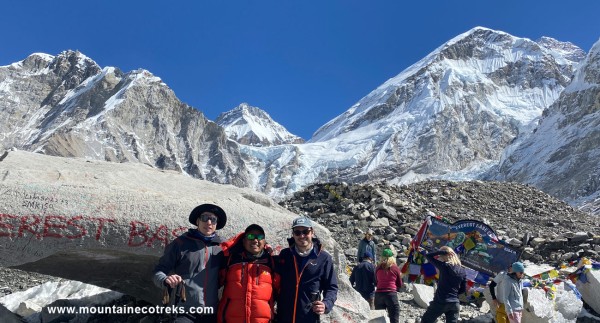
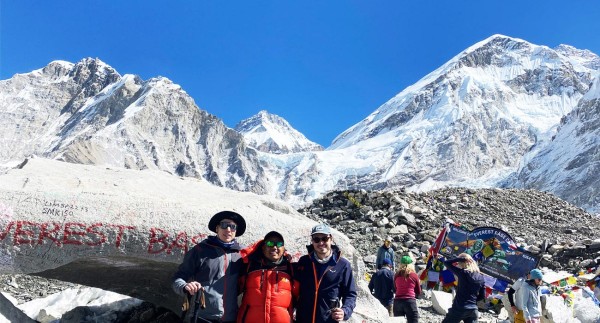
The long one. A rough traverse over glacial moraine to Gorak Shep - and "trail" is generous here, since the whole surface sits on moving ice and gets rerouted most seasons. Lunch, then the final push to Base Camp. In spring you'll walk into the expedition tent city with the Khumbu Icefall towering behind it.
A thing that surprises almost everyone: you cannot see Everest from Everest Base Camp. Nuptse blocks it entirely. The mountain you're standing at the foot of is invisible from where you're standing.
Back to Gorak Shep to sleep - badly, most likely.
You'll probably wake around two in the morning, suddenly, feeling like you'd stopped breathing. You had. It's called periodic breathing and at 5,164 m it's normal, not an emergency. Knowing that in advance is worth a lot at two in the morning.
Day 9 - Kala Patthar at dawn, then helicopter to Kathmandu
Walking: 3 hrs · Ascent: ~380 m · Flight: ~40 min total
Up in the dark for the climb to Kalapatthar (5,545 m), where Everest finally reveals its full summit pyramid. Back for breakfast, then the helicopter.
Keep your camera battery inside your jacket against your body until the moment you shoot. At −15 °C a full battery reads empty in about ten minutes, warms back up, and works fine again. Half the people up there think their camera has died.
Your bag gets weighed, and so, more discreetly, do you. Weight limits at that altitude aren't a formality - they're the difference between the aircraft lifting and not.
Then eight days of walking scrolls past underneath you in about twenty-five minutes.
Day 10 - Buffer day in Kathmandu
Every honest itinerary has one. Himalayan weather does not care about your connecting flight.
Ready to walk it?
Mountain Eco Treks runs this itinerary with Khumbu-born guides, direct Kathmandu–Lukla flights, and a written weather-delay policy. Tell us your travel window and we'll send departure dates and a straight price - no deposit needed to ask.
View the Everest Base Camp Trek With Helicopter Return →
Altitude Profile
| Night | Village | Sleeping altitude | Gain from previous night |
|---|---|---|---|
| 1 | Phakding | 2,610 m | — |
| 2 | Namche Bazaar | 3,440 m | +830 m |
| 3 | Namche Bazaar | 3,440 m | Acclimatisation |
| 4 | Tengboche | 3,860 m | +420 m |
| 5 | Dingboche | 4,410 m | +550 m |
| 6 | Dingboche | 4,410 m | Acclimatisation |
| 7 | Lobuche | 4,940 m | +530 m |
| 8 | Gorak Shep | 5,164 m | +224 m |
| 9 | Kathmandu | 1,400 m | −3,764 m (by air) |
Above 3,000 m the guideline is 300–500 m of sleeping-altitude gain per day. The Namche day exceeds it, which is exactly why the following day is a rest day - and why the same pattern repeats at Dingboche.
Helicopter Return vs Walking Back
| Factor | Helicopter Return | Walking Back |
|---|---|---|
| Trip length | 9–11 days | 12–14 days |
| Extra cost | ~USD 1,000–15,00 | Nothing |
| Impact on knees | Minimal | Significant |
| Time at altitude after summit day | Minutes | 3–4 days |
| Aerial views of Khumbu Icefall | Yes | No |
| Weather-delay risk | Moderate to high | Low |
| Money staying in the valley | Less | More |
That last row isn't a throwaway. Community leaders in the Khumbu have been vocal that growing helicopter traffic pulls income away from porters, guides and teahouses in the lower valley, and adds noise to a UNESCO World Heritage landscape. Flying out is a perfectly reasonable choice. Flying out while tipping properly, spending a full night in Namche, and buying gear locally is a better version of it.
The name Mountain Eco Treks isn't decoration. We staff every departure with Khumbu-based guides and porters on fair wages with insurance, we hold porter loads to recommended limits, and we build a full night into Namche rather than a rushed exit - so the valley still sees the money even when you fly out.
What It Costs
Package tiers
| Package | Typical price (per person) | What you get |
|---|---|---|
| Budget | USD 2,295–2,600 | Standard teahouses, shared rooms above Namche, shared helicopter seat, group departure |
| Standard | USD 2,700–3,200 | Better-rated lodges, private twin rooms where available, shared helicopter, smaller group |
| Premium | USD 3,300–3,999 | Upgraded lodges with attached bathrooms and heating, private guide, priority helicopter seating |
Want the upgraded-lodge experience across the whole route? Price out the Everest Base Camp Luxury Trek -same trail, considerably softer landings.
What moves the number
Shared seat or private charter. A shared seat on the return flight is usually USD 1,200–1,400. Chartering the whole aircraft for two or three people can hit USD 2,500–4,000. Almost every advertised package price assumes shared - check the contract, not the brochure.
Lodge standard. Basic teahouse twins versus the upgraded lodges at Namche, Deboche and Dingboche is a swing of USD 200 or more.
Group size. Solo travellers pay a supplement. Six or more gets a materially better rate and makes a shared helicopter far easier to fill.
Season. Peak-season departures in mid-October and late April carry a premium and sell out months ahead.
Permits and government fees (2026)
| Permit | Cost (foreign nationals) |
|---|---|
| Sagarmatha National Park Entry Permit | NPR 3,000 (~USD 20) |
| Khumbu Pasang Lhamu Rural Municipality Permit | NPR 3,000 (~USD 20) |
| TIMS card | Not required in the Khumbu |
The municipality permit is issued in Lukla or Monjo, not Kathmandu - you can't buy it in advance from the Tourism Board. Note that the guide requirement introduced for Nepal's national parks in 2023 was never adopted in the Khumbu, where the local municipality continued to allow independent trekkers, so a guide is not mandatory on this route. We include one on every departure anyway, for reasons that become obvious somewhere around Thukla Pass.
Not included
International flights · Nepal visa · Travel Insurence · personal gear · hot showers above Namche · Wi-Fi · charging (typically 200–500 rupees per device per hour above Dingboche) · bar bills · tips.
Get a straight price for your dates
Different seasons, group sizes and lodge standards move the number a lot. Send us your window and we'll quote it properly rather than making you guess from a range.
Request dates and pricing →
When to Go
 Weather matters more here than on the standard Everest Base Camp Trek, because your exit depends on an aircraft being able to fly. Our full Everest weather guide breaks it down month by month.
| Season | Months | Verdict |
|---|---|---|
| Spring | Mar–May | Strongest window. Stable mornings, rhododendrons below Namche, expedition season alive at Base Camp |
| Autumn | Late Sep–Nov | Clearest air of the year. Cold nights above Dingboche. Mid-October is the busiest fortnight |
| Winter | Dec–Feb | Empty trails, extraordinary visibility, brutal cold at Gorak Shep, some lodges closed, more cancellations |
| Monsoon | Jun–Aug | Not recommended for a helicopter itinerary. Cloud will ground you for days |
One rule no brochure prints clearly enough: helicopters in the Khumbu fly in the morning, usually before 10 or 11 a.m., before valley cloud and wind build. If your return flight is scheduled for the afternoon, someone is being optimistic.
Altitude: Take This Seriously
Everest Base Camp sits at 5,364 m, where you're breathing about half the oxygen you'd get at sea level. Mild altitude sickness is common. Serious cases are rare, but they escalate fast.
- Above 3,000 m, gain no more than 300–500 m of sleeping altitude per day.
- Keep both acclimatisation days. Both.
- Drink three to four litres daily, even when you don't want to.
- Tell your guide about headache, nausea, poor appetite or wobbly balance when it happens - not next morning over breakfast.
- If it worsens, go down. Altitude illness has one reliable cure and it's elevation loss.
Talk to your doctor about acetazolamide before travelling. One quiet advantage of this itinerary: a helicopter is already in the plan, and a guide carrying a pulse oximeter can bring your lift forward if someone is struggling.
Insurance is not optional. Your policy must specifically cover trekking to 6,000 m and helicopter evacuation — standard travel insurance almost never does. Read the exclusions, not the summary page. We've written up what to look for in our trekking insurance guide.
Getting Fit Enough
You don't need to be an athlete. You need to walk five to seven hours a day, on rough ground, for eight days straight, with less oxygen than you're used to.
| Phase | Weeks | Focus |
|---|---|---|
| Base | 1–4 | 3 cardio sessions weekly (45–60 min) + one longer weekend walk |
| Build | 5–8 | Add a 6–8 kg daypack. Weekend hikes of 4–5 hrs with real elevation |
| Peak | 9–12 | Back-to-back weekend hikes. Step-ups, lunges, calf raises |
Descending is what destroys untrained legs, so train the eccentric work even though you're flying back. And break your boots in on actual trails. The number one trip-wrecker in the Khumbu isn't altitude - it's blisters.
Packing Checklist
Layers
- Base layers ×2 (merino, not cotton)
- Fleece or light down mid-layer
- Insulated down jacket (−15 °C rating)
- Waterproof shell, jacket and trousers
- Trekking trousers ×2
Feet
- Broken-in waterproof boots with ankle support
- Liner socks + wool socks ×4
- Camp shoes for the lodges
Sleep
- Sleeping bag rated −15 °C (rentable in Kathmandu)
- Silk or fleece liner — lodge doors don't seal
Kit
- Trekking poles (genuinely worth it)
- Headtorch + spare batteries
- Sunglasses, category 3 or 4
- SPF 50 and lip balm with SPF
- Water filter or purification tablets
- Power bank, 20,000 mAh
- Personal first-aid kit and blister plasters
Documents
- Passport + photocopies
- Passport photos ×4
- Insurance certificate with the evacuation clause printed
One Thing to Verify Before You Pay
Helicopter policy inside Sagarmatha National Park has been genuinely contested. Restrictions on commercial flights were brought in and then substantially eased after negotiations between the park authority, the local municipality and Nepal's airline operators. Return flights for trekkers are operating - but rules on landing points, passenger numbers and permitted altitudes have shifted more than once.
Ask any operator, in writing:
- Where exactly will the helicopter pick us up?
- How many passengers per lift at that altitude?
- What happens to my booking if weather or regulation stops the flight?
A good agency answers all three without hesitating. One that gets vague on question three is telling you something.
For the record, ours are: pickup at Gorak Shep or Pheriche depending on conditions; two to three passengers per lift at that altitude, staged through Lukla; and if weather grounds the flight, we hold you at Pheriche at our cost for a window, or walk you out to Lukla with your guide and refund the unused air segment.
Still deciding?
Compare the three Everest options side by side, or send us a message with your dates and we'll tell you honestly which one fits.
Helicopter Return · Classic Trek · Luxury Trek
Common Questions
How many days is the Everest Base Camp Trek With Helicopter Return?
10 days including arrival and a weather buffer. The trekking portion is 8 days from Lukla to Base Camp.
How much does it cost?
USD 2,295 to USD 3,999 per person all-in, depending on lodge standard and group size. The helicopter leg alone adds roughly USD 1,200–2,000 on a shared basis.
Where does the helicopter pick you up?
Normally Gorak Shep (5,164 m) or Pheriche (4,371 m), depending on operator, aircraft performance and current regulations. Most flights stage through Lukla before continuing to Kathmandu.
Is the helicopter flight safe?
Nepal's Civil Aviation Authority has tightened standards for Everest-region operations, including passenger limits at altitude. Flights only go in clear morning conditions with licensed operators. The realistic risk isn't danger — it's delay.
What if the helicopter can't fly?
You either wait at Gorak Shep or Pheriche for a window, or walk out to Lukla. Get the refund and rescheduling policy in writing before paying a deposit. It's the most important clause in the contract.
Can a beginner do this trek?
Yes. There's no technical climbing. It asks for cardiovascular endurance, patience with altitude, and tolerance for basic lodges. First-timers finish it every season.
Do I still need permits if I'm flying back?
Yes — both the Sagarmatha National Park permit and the Khumbu Pasang Lhamu Rural Municipality permit, regardless of how you leave.
Is Kala Patthar included?
On most itineraries, yes, as a pre-dawn climb on flight morning. Worth the cold start: Kala Patthar gives a better view of Everest's summit than Base Camp does, where Nuptse hides it entirely.
Can I trek solo?
Yes. The 2023 guide rule for national parks wasn't adopted in the Khumbu, so independent trekking is still permitted. Whether it's wise is a separate question — above Dingboche, having someone who reads altitude symptoms and can call a helicopter matters.
Is there Wi-Fi and charging on the trail?
Wi-Fi is available in most lodges up to Dingboche, patchy above. Everest Link cards are the usual system. Charging costs 200–500 rupees per device per hour at altitude - bring a large power bank.
How is this different from an Everest helicopter day tour?
Completely different trips. A day tour is a single flight from Kathmandu with a brief landing - no trekking. This is a full trek on foot with only the return leg flown.
So Is It Worth It?
If time is your constraint, this is the best-value itinerary in Nepal. You lose almost nothing that matters - every village, every viewpoint, every acclimatisation day stays exactly where it is - and you swap four days of backtracking for a flight most people describe as the most memorable half hour of the trip.
If money is your constraint, walk back. The descent is unremarkable but it's cheap, reliable, and gives you a completely different read on the Khumbu at a fitness level you didn't have on the way up.
And if you're genuinely torn: book the trek with the helicopter as a flexible add-on, then decide at Dingboche based on how your body actually feels. Letting the mountain make the call is usually the smartest way to plan anything in the Himalaya.
Trek With Mountain Eco Treks
We're a Nepal-registered, locally owned trekking company based in Kathmandu, running the Khumbu with Government-licensed guides, fair porter wages and insurance, small groups, direct Kathmandu–Lukla flights, and permits handled end to end.
| Package | Days | Return | From |
|---|---|---|---|
| Everest Base Camp Trek With Helicopter Return | 10 | Helicopter | USD 2,295 |
| Everest Base Camp Trek | 14 | On foot | Enquire |
| Everest Base Camp Luxury Trek | 12 | Optional helicopter | Enquire |
Tell us your travel window and we'll come back with departure dates, a straight price, and whether a shared helicopter seat is likely to be available - no deposit needed to ask.
Mountain Eco Treks · Kathmandu, Nepal
Recent From Blog

19th Apr, 2019


23rd Dec, 2018

11th Jan, 2024

14th Jan, 2024

29th Jan, 2025

11th Feb, 2025

18th Feb, 2025

25th Feb, 2025

5th Apr, 2025
23rd Dec, 2025