Everest Base Camp Trek
US$3599 P/P
The Everest Base Camp Trek with Helicopter Return-10 Days is not just another trekking package - it is one of the most complete and rewarding EBC helicopter trek Nepal experiences designed for travelers who want the full Everest adventure without spending two weeks on the trail. For those seeking an even more indulgent experience, the Everest Base Camp Luxury Trek offers premium comfort at every step of this same iconic journey. Operated by Mountain Eco Treks, this itinerary gives you everything - the culture, the views, the achievement - in just 10 unforgettable days.
Your journey starts with a helicopter flight from Kathmandu to Lukla (2,860m), putting you straight into the heart of the Khumbu region and saving 2 full days from the very beginning. From there, the trail leads through Sagarmatha National Park (UNESCO World Heritage Site), passing the legendary Namche Bazaar (3,440m) and the peaceful Tengboche Monastery (3,867m).
Continuing through the high-altitude villages of Dingboche (4,410m) and Lobuche (4,940m), you finally arrive at Everest Base Camp (5,364m) - a moment that feels every bit as powerful as you imagined. The crown of this journey is Kala Patthar (5,545m / 18,192ft), where sweeping views of Mount Everest (8,848m), Lhotse (8,516m), Nuptse (7,861m), Ama Dablam (6,812m), and Pumori (7,161m) stretch endlessly before you. Adventurers looking to explore further into the Himalayas often combine this route with the Gokyo Lake Trek, adding the stunning turquoise lakes of the Gokyo Valley to their Everest experience. Rated moderate in difficulty, the ideal seasons are spring (March - May) and autumn (September - November).
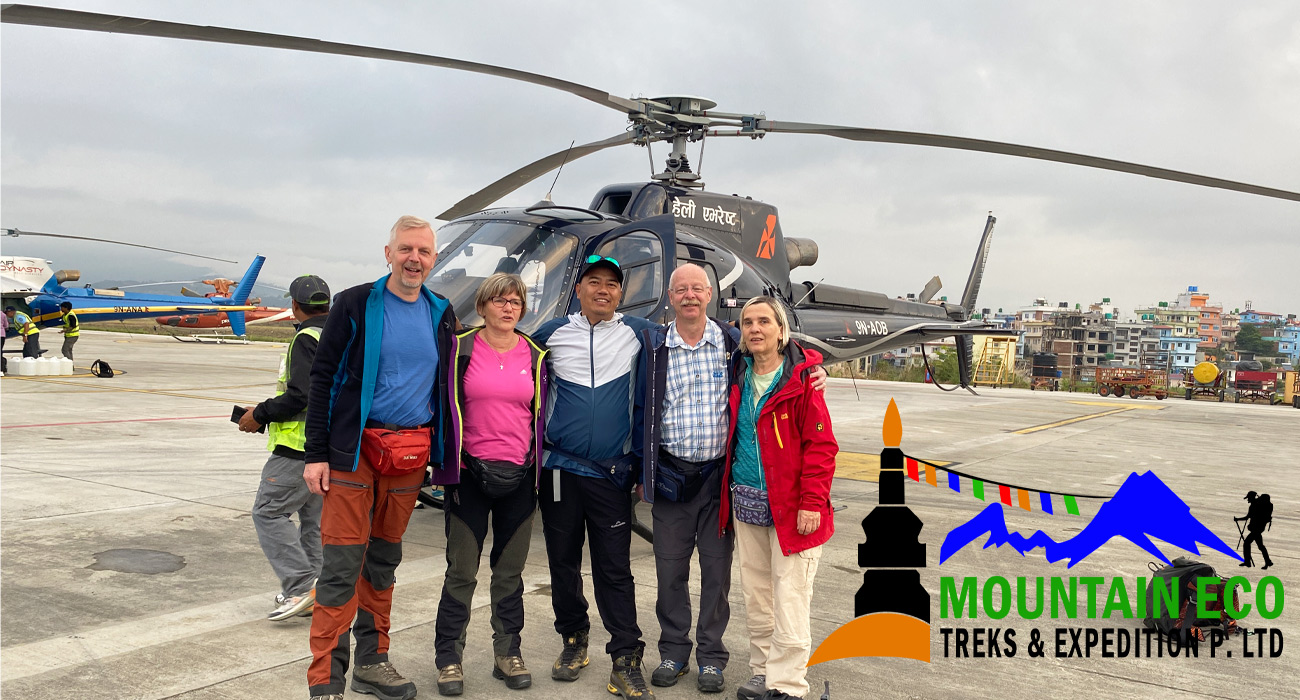
Instead of spending 2 to 3 tired days retracing the descent on foot, you step onto a helicopter at Gorakshep, soar above the Khumbu Glacier one final time, and land back in Kathmandu the same day - rested, exhilarated, and with memories that stay with you forever. For those with more time and a bigger appetite for adventure, the Everest Three High Passes Trek offers an extended circuit crossing the dramatic Kongma La, Cho La, and Renjo La passes. For busy travelers short on time, this fly back from Everest Base Camp option is genuinely one of the smartest choices you can make.
The EBC trek 10 days package cost includes helicopter flights, an experienced government-licensed Everest trekking guide, teahouse accommodation, all meals on the trail, and the Sagarmatha National Park entry permit. Whether you choose the Standard option or a more premium high-altitude helicopter trek Nepal experience, Mountain Eco Treks-one of Nepal's most trusted Himalayan trekking companies-takes care of every detail so you can focus entirely on the journey.
Note: This itinerary is available in Luxury, Standard, and Budget-friendly categories to suit different travel preferences and budgets. For complete details on what is included and excluded, please refer to the Cost Includes & Excludes section below.
On arrival by respective airlines, you will be welcome by Mountain Eco treks, a short drive to a hotel in Kathmandu, our representative will inform you about trek-hotels with the necessary information to get refreshments in your room at hotels.
The morning According to your flight schedule is a delightful scenic flight to Lukla by sharing helicopter amid breathtaking views of the mountains and then the first day begins with 3 hours of trekking following the Dudhkhosi Valley before climbing to the Ghats and Phakding. Phakding village for an overnight stop.
A long day's walk from the large Sherpa village of Namche Bazaar is almost a long day's walk to the town, where a morning walk crosses a few bridges upstream of the Dudh Koshi River to enter the Everest National Park entrance near the village of Monzo. (Chomolungma means 'Great Mother' in both the Everest and Sherpa languages for Everest in Nepal). From here a pleasant riverside walk leads to a few hours of climbing through the forest with views of snow-capped peaks, as our walk takes you to Namche market. Namche holds a colorful and busy Saturday market once a week and offers you great views of Mt Everest, Amadablam, and other peaks.
At this high altitude of over 3,440 meters, it is important and necessary to have a free day and rest at Namche Bazar before proceeding to higher altitudes. Spend your day in Namche with a scenic walk around and explore the streets of Namche Market, lined with shops, boutiques, and bakeries with lots of nice restaurants. Namche hosts a colorful and busy Saturday market once a week, a walk to Everest View Hotel or the top of Namche Hill is suggested for a great view of Everest and Amadablam. and a more beautiful mountain.
From Namche, the drive takes a gradual scenic winding route downhill to reach Phunge-Tenga with magnificent views of snow-capped peaks, and snow-capped peaks in the afternoon. After a few hours of scenic climbing reach Thangboche Monastery, enjoy the magnificent view of Mt Amadablum with Everest, Nuptse, Lhotse, Kangtenga, Tharmarserku, and Kongde, free afternoon visit to Tengboche Monastery and observe young monks and lovers. Chanting prayers fill this beautiful atmosphere. Thangboche, surrounded by lovely green woods, celebrates Mani-Rimdu, an important colorful festival celebrated in October every year according to the Buddhist calendar.
The morning begins with an hour's descent to the Imjatse River, crossing a bridge and then into open country where the tree lines drop to some short juniper and rhododendron thickets, then a short climb to the village of Pangboche at 3,900m.Pangboche is the last standing village on the way to Everest base camp, from here slow climb to Somare for lunch and continues walking with a short climb to Dingboche village for an overnight stop, situated in the scenic wide Imja valley for excellent views of Amadablam North Face and Island Peak.
Relax for another favorable day, where you can take a short hike to the Nagarjung Hills for great views of the surrounding peaks with the Makalu Mountains to the east. For the more energetic, an optional hike to Chukung at 4,760m, a small settlement within the Imjatse Valley offers incredible views of the Island Peaks, Lhotse Shar, Lhotse, Nuptse, and Amadablam.
After a good and pleasant overnight stay at Dingboche, the morning walk leads to a short climb facing the peaks, and then a gradual trail for lunch to reach Thagla, where the giant Khumbu glaciers melt into raging rivers. Here the route from Pheriche and Dingboche joins Everest Base Camp, after an hour's steep climb to the top of the mountain known as Thagla Pass, where there are stone memorials to the unfortunate climbers who died on Everest, Lhotse, or other climbs. High mountain expeditions. From here a nice walk to Lobuche for an overnight stop.
Today's adventure trek is the highlight of the trip as it takes a short steep climb between glaciers and moraines to reach Gorakshep under the high peaks of Pumori and the rocky hills of Kalapathar at Everest base camp. The trek continues towards Everest Base Camp, enjoy the view of the huge Khumbu Ice Fall and Glacier at the Base Camp, and after an exciting time with the experience of a lifetime, travel back to Gorakshep for an overnight stop.
On the final day of your Everest adventure, you will climb to Kalapathar (5,545 meters) in the Khumbu and Everest region. The ascent and descent take approximately 3 to 4 hours, offering the highest viewpoint of your trek with breathtaking panoramic views of Mount Everest and surrounding peaks. After enjoying this unforgettable experience, return to Gorakhshep for breakfast before boarding a scenic helicopter flight back to Kathmandu. Depending on weather conditions, there may be a brief waiting period. During the flight, relish amazing close-up views of the Himalayas. Occasionally, the helicopter may stop for an hour at Lukla or the Everest View Hotel before continuing to Kathmandu. Upon arrival, you will be transferred to your hotel, concluding your remarkable journey.
Note: All trekking hours and distances are approximate. Mountain weather can be unpredictable, even during the peak trekking seasons (March to May and September to November). We highly recommend allocating a few extra days at the end of your trek to ensure a safe and comfortable journey.
Service Types
Compare the available package types and choose the service level that matches your comfort, budget, and support needs.
Luxury Package Cost
US$ 3999 per person
Standard Package Cost
US$ 3195 per person
Budget Package Cost
US$ 2295 per person

The Everest Base Camp Trek with Helicopter Return is a specially designed trekking package that takes you on foot through the breathtaking Khumbu Valley all the way to Everest Base Camp at 5,364 meters, and then flies you back to Kathmandu by helicopter. Instead of spending extra days walking the same trail downhill, you get a dramatic aerial exit with sweeping views of Mount Everest, the Khumbu Glacier, and the surrounding Himalayan giants. It is the most efficient and visually rewarding way to complete the EBC journey.
This package typically takes between 10 to 12 days from Kathmandu. The trek follows a carefully paced acclimatization schedule through villages like Namche Bazaar, Tengboche, Dingboche, and Lobuche before reaching Everest Base Camp and the viewpoint of Kalapatthar. The helicopter return on the final morning brings you back to Kathmandu within 2 hour, saving you 4 to 5 days of downhill walking.
At Mountain Eco Treks, we offer three package levels to suit different budgets and travel styles:
| Package Type | Starting Price (Per Person) |
|---|---|
| Budget Package | USD 2,295 |
| Standard Package | USD 3,195 |
| Luxury Package | USD 3,999 |
The difference between packages reflects the standard of lodge accommodation, level of personal service, and additional inclusions. Contact our team for a detailed breakdown of what each package covers and to find the best fit for your group.
A well-structured EBC helicopter return package typically covers your Kathmandu hotel stay, the Kathmandu to Lukla return flights, all lodge accommodation along the trekking route, three meals a day during the trek, a licensed and experienced trekking guide, one porter per two trekkers, all required trekking permits, and your helicopter seat from Gorak Shep back to Kathmandu.
Items not usually included are your international flights to Nepal, your Nepal entry visa fee, personal travel and medical insurance, personal trekking gear and clothing, snacks and beverages beyond the standard meals, tips for your guide and porter, and any costs arising from unexpected delays or emergency situations.
Yes, travel insurance is absolutely required. Your policy must specifically cover high-altitude trekking up to at least 5,500 meters and emergency helicopter evacuation from altitude. A rescue helicopter in the Khumbu region can cost anywhere from USD 3,000 to USD 10,000, and without valid insurance, you bear that cost entirely yourself. Any reputable trekking company in Nepal will ask to see your insurance details before your departure.
The most common helicopter pickup point is Gorak Shep at 5,164 meters, which is the last village before Everest Base Camp. If your itinerary includes an early morning hike to Kalapatthar, some operators arrange the helicopter pickup directly from there at 5,545 meters. The flight to Kathmandu takes roughly 1 to 2 hrs including fueling in lukla and delivers some of the most remarkable aerial mountain scenery on the planet.
Yes, it can. Helicopter flights in the Himalayas operate entirely subject to weather conditions. Low clouds, high winds, snowfall, or poor visibility can delay or postpone your flight by one to three days. This is a normal part of high-altitude helicopter operations in Nepal. You should always allow buffer days in your travel schedule and avoid booking an international departure flight immediately after your planned trek end date.
You need two permits to trek in the Everest region. The first is the Sagarmatha National Park Entry Permit, which costs approximately NPR 3,000. The second is the Khumbu Pasang Lhamu Rural Municipality Entry Permit, which costs approximately NPR 2,000. Both are arranged by your trekking operator and are typically included in the package price.
Prior experience in high-altitude trekking is helpful but not strictly necessary. What matters most is a good base level of fitness and a commitment to preparing physically for 2 to 3 months before the trek. You should be comfortable walking 5 to 8 hours daily on uneven mountain terrain. The helicopter return removes the most physically demanding part of the standard trek, which is the multi-day descent, making this version more accessible to first-time trekkers.
Altitude sickness, medically known as Acute Mountain Sickness or AMS, is a genuine concern on any trek above 3,500 meters. Symptoms can include headache, nausea, dizziness, fatigue, and loss of appetite. The itinerary is designed with deliberate acclimatization days at Namche Bazaar and Dingboche to help your body adjust gradually. Ascending slowly, staying well hydrated, and never ignoring early symptoms are the most important safety practices on this trek. Speak to your doctor before departure about preventive medication options.
Spring, from March to May, and autumn, from late September to November, are the two best seasons. Both offer stable weather, manageable temperatures, excellent mountain visibility, and reliable helicopter flying conditions. Spring brings blooming rhododendrons along the lower trails, while autumn delivers the clearest post-monsoon skies. Winter treks are possible but involve extreme cold and a higher risk of flight disruption. The monsoon months of June through August are best avoided due to heavy rainfall and poor trail conditions.
Pack in layers, as temperatures vary greatly between lower villages and high altitude. Essential items include a warm down jacket, waterproof outer shell, thermal base layers, moisture-wicking trekking clothes, a fleece mid-layer, sturdy waterproof trekking boots that are already broken in, wool or synthetic trekking socks, UV-rated sunglasses, a warm hat and gloves, a headlamp, trekking poles, sunscreen of at least SPF 50, a basic first aid kit, and a power bank. A sleeping bag rated to minus 15 degrees Celsius is also recommended.
Senior trekkers in good health have successfully completed the Everest Base Camp trek well into their 60s and 70s. A thorough pre-trek health checkup is strongly advisable, and the helicopter return makes the experience significantly less physically demanding. For younger trekkers, most operators recommend a minimum age of around 12 to 14 years. Children must be accompanied by adults and should have a reasonable level of fitness and maturity for the challenge ahead.
The helicopter return saves you 4 to 5 days of repetitive downhill walking that puts significant strain on your knees, ankles, and energy levels. It also gives you something the standard trek cannot offer: a breathtaking bird's eye view of Everest, the Khumbu Icefall, and the entire Himalayan range from the air. For trekkers with limited holiday time, those who prefer a less physically intensive descent, or anyone who wants to end their Everest journey on the highest possible note, the helicopter return is the clear choice.
The Everest Base Camp Trek with Helicopter Return is rated as moderate to challenging. Daily walking hours range from 5 to 8, the terrain is mountainous and sometimes steep, and the altitude presents its own physical demands. However, no technical climbing skills are required. With proper preparation, a steady pace, and a willingness to listen to your body and your guide, this trek is well within reach for any reasonably fit and motivated person.
Mountain Eco Treks makes the booking process simple and transparent. Reach out to our team with your preferred travel dates, group size, and budget, and we will send you a tailored itinerary and package quote. Once confirmed, a deposit secures your booking and we handle all logistics including permits, domestic flights, guide and porter assignments, lodge reservations, and helicopter arrangements. We recommend booking at least 4 to 8 weeks in advance, particularly for spring and autumn departures.
Foreign nationals can obtain a Nepal tourist visa on arrival at Tribhuvan International Airport or at designated land border entry points from India and Tibet. Travelers can also apply for an online visa in advance through the official immigration system.
To apply for a Nepal visa, travelers need:
Visa fees and rules may change as per Nepal Immigration regulations.
Tourist visas can be extended at the Department of Immigration in Kathmandu.
Advice to Travelers
Trekkers visiting national parks, conservation areas, and restricted regions such as the Everest Region, Annapurna Region, and Manaslu Region require trekking permits. Some restricted areas also require special permits issued through a registered trekking agency in Nepal.
Plan Your Nepal Adventure with Mountain Eco Treks
Mountain Eco Treks is a trusted local trekking and tour company based in Nepal, offering professional trekking, tour, climbing, and adventure travel services across the Himalayas.
We organize:
Our team provides complete travel support including permits, transportation, accommodation, and guided trekking experiences across Nepal.
Contact Mountain Eco Treks
For official Nepal visa information, visit: https://immigration.gov.np/?utm_source=chatgpt.com
Mountain Eco Treks & Expeditions (P) Ltd is a Nepal Government-registered trekking company based in Kathmandu, operating tours and expeditions across Nepal, Tibet, and Bhutan. Please read these terms before booking.
We accept Visa, Mastercard, and bank wire transfer. Additional bank charges may apply.
All cancellations must be made in writing.
| Notice Period | Charge |
|---|---|
| 50+ days | Deposit retained |
| 30 days | 50% of total |
| 2 weeks | 75% of total |
| 1 week or less | 100% - no refund |
A 20% non-refundable deposit applies in all cancellation cases. No refund is issued for incomplete trips or early departures from the itinerary.
If we cancel due to weather, natural disaster, or unrest, we offer an alternative trip or full refund. Any personal expenses (flights, visas) remain your responsibility.
Himalayan travel involves unpredictable weather, road conditions, and remote flight routes. We minimize disruptions where possible, but extra costs during delays are the client's responsibility. No refunds for itinerary changes beyond our control.
By booking with us, you agree to all terms above.
Mountain Eco Treks & Expeditions (P) Ltd 🌐 www.mountainecotreks.com
Mountain Eco Treks is a licensed local Nepal trekking company based in Kathmandu, founded by Ram Bahadur Tamang, a mountain leader with more than 15 years of trekking and expedition experience across Nepal and Tibet. Registered with the Nepal Tourism Board (NTB) and TAAN, we provide reliable trekking services with a strong focus on safety, local expertise, and responsible tourism.
We operate as a fully registered trekking company in Nepal with transparent services and recognized tourism affiliations.
Our NTB-certified guides are first-aid trained and have extensive experience leading trekkers on Nepal’s most popular Himalayan routes.
Daily acclimatization monitoring, proper trip planning, and emergency preparedness are part of every trek we organize.
From permits and transportation to accommodation, meals, and porters, we manage the logistics so you can focus on the journey.
No hidden charges and flexible options for private or group treks to suit different travel styles and budgets.
We support eco-friendly trekking practices, local communities, and initiatives that benefit villages and preserve the mountain environment.
| Item | Details |
|---|---|
| T-Shirts | 3–4 moisture-wicking shirts |
| Fleece Jacket | Warm mid-layer for cold mornings |
| Down Jacket | Essential above 3,000 m |
| Waterproof Jacket | Wind and rain protection |
| Trekking Trousers | Quick-dry lightweight pants |
| Wool Socks | 3-4 warm trekking pairs |
| Gloves & Hat | Cold-weather protection |
| Buff / Scarf | Dust and wind protection |
| Item | Details |
|---|---|
| Trekking Boots | Waterproof with ankle support |
| Sandals / Slippers | Comfortable for evenings |
| Item | Details |
|---|---|
| Daypack | 10-15L daily backpack |
| Trekking Poles | Reduces knee strain |
| Water Bottle | Refillable 2-liter bottle |
| Item | Details |
|---|---|
| Passport | Valid 6+ months |
| Nepal Visa | Required for entry |
| Travel Insurance | Includes evacuation coverage |
| Passport Photos | For permits and documents |
| Cash & Card | Local cash recommended |
| Item | Details |
|---|---|
| Painkillers | Headache and muscle relief |
| Anti-Diarrheal | For stomach issues |
| Bandages | Basic injury care |
| Sunscreen SPF 50+ | High-altitude UV protection |
| Lip Balm | Prevents dry lips |
| Prescription Medicine | Personal medical supply |
| Item | Details |
|---|---|
| Headlamp | With spare batteries |
| Sleeping Bag | Suitable for cold temperatures |
| Sunglasses | UV400 protection |
| Water Purification | Tablets or filter |
| Item | Details |
|---|---|
| Mobile Phone | Offline maps recommended |
| Camera | Extra batteries advised |
| Power Bank | High-capacity backup |
| Travel Adapter | Nepal 2-pin plug |
| Item | Details |
|---|---|
| Energy Bars | Quick trail snacks |
| Electrolyte Drinks | Hydration support |
Enjoy a hassle-free round-trip helicopter experience- thrilling helicopter rides for both outbound and return journeys. Skip the hassle of the Lukla-Kathmandu flight with direct helicopter options to Kathmandu, offering a far more comfortable and stress-free experience compared to trekking back.
Safer Choice for Altitude Sickness : If you experience mild altitude sickness at EBC or Gorekshep, a helicopter return can help you descend faster. This reduces the risk of Acute Mountain Sickness (AMS).
Breathtaking Aerial Views : Enjoy breathtaking helicopter views of Everest, Ama Dablam, Nuptse and the Khumbu Glacier.
Skip the Long Descent : The return trek from EBC to Lukla can be physically tiring.A helicopter return saves 3-4 days of hiking, reducing fatigue and stress on the legs.
Save Valuable Time : The EBC trek takes around 12-14 days, but with a helicopter return, you can reduce it to 8-10 days.This is the perfect trek package for trekkers with limited vacation time.
Perfect for Photography : Ideal for trekkers who want to capture stunning aerial images of the Everest region.Great for professional videographers or travel bloggers.
Fully Customizable Itinerary : As the helicopter offers flexibility in planning, you can adjust your trek duration.It is possible to combine it with a flight over EBC and Gokyo Lake.
More enjoyable experience: Skip the early drive to Ramechhap and avoid repeating trails, keeping your Everest Base Camp trek fresh and energizing. Enjoy EBC and Kala Patthar to the fullest without worrying about the return journey.
Experience the Himalayas safely and comfortably by trekking to Everest Base Camp (EBC) with a helicopter return. Follow these expert tips from Mountain Eco Treks for a successful adventure.
Mental Preparation: Understand high-altitude challenges. Watch for symptoms like headache, dizziness, or nausea, and stay mentally ready for the trek.
The Everest Base Camp trek with helicopter return is Nepal's most popular Himalayan trekking package. It follows the classic EBC route through the Khumbu Valley to Base Camp (5,364 m) and Kalapatthar (5,545 m), then flies you back to Kathmandu by helicopter - saving two to three days of descent. Most packages run 10 to 12 days with teahouse accommodation and meals included throughout.
Here is everything you need to know about where you sleep, what you eat, and what it costs.
All accommodation on the EBC route is in teahouses - locally owned mountain guesthouses along the trail from Lukla to Base Camp. Comfortable and well-equipped in the lower villages, simple and basic at higher elevations.
In Namche Bazaar (3,440 m), Tengboche (3,860 m), and Dingboche (4,410 m), expect private rooms, hot showers, electric blankets, and Wi-Fi. Namche especially is warm, welcoming, and well worth upgrading your lodge - you spend at least two nights here for acclimatisation anyway.
Above Lobuche (4,940 m) and into Gorak Shep (5,164 m), rooms are small, bathrooms are shared, and the cold is relentless. It is part of the experience - and one of the best reasons to choose the helicopter return. You spend just one night up there before flying out, rather than walking back down through it all.
Food on the EBC trail is genuinely better than most people expect - hot, fresh, and available at every stop from Lukla to Base Camp.
Eat dal bhat every single day. Nepal's national dish of lentil soup, steamed rice, and vegetables is the best fuel you can put in your body at altitude. Always hot, always refillable, and available at every teahouse on the Khumbu trail. Every Sherpa guide gives the same advice - eat dal bhat as often as possible.
Most teahouses also serve pasta, eggs, soups, momos, and Tibetan bread. Garlic soup is a local staple widely believed to help with acclimatisation - worth ordering above 4,000 m. Momos are the perfect trail snack at any elevation. Tibetan bread with honey for breakfast is one of those small pleasures you remember long after the trek is over.
Drink constantly. Ginger tea, lemon tea, chai, and fresh coffee are available everywhere on the route. Staying hydrated is the single best defence against altitude sickness on the EBC trek - aim for three to four litres daily. Use a purification filter bottle rather than single-use plastic-Sagarmatha National Park is a UNESCO World Heritage Site and deserves better.
Costs increase with altitude as supplies become harder to transport by porter and yak to higher elevations.
Accommodation is included in most organised EBC helicopter return packages on a twin-sharing basis. If booking independently, premium lodges in Namche Bazaar and Dingboche run USD 30-40 per night.
Dal bhat costs USD 10-12 in Namche Bazaar and up to USD 12-15 near Gorak Shep. Hot drinks run USD 5-7 throughout the route. A hot shower costs USD 8-10 at higher elevations.
Daily food budget - plan for USD 50-60 per day if meals are not included in your package. Most organised packages cover breakfast and dinner, with lunch purchased independently on the trail.
Overall package cost - a fully organised EBC trek with helicopter return in 2026 ranges from USD 2,300 to USD 4,000 depending on group size, lodge quality, and inclusions. Solo private packages with premium accommodation sit at the higher end.
On the way up, the experience is the same for every trekker - same teahouses, same dal bhat, same trail. The helicopter return changes the ending. After reaching Everest Base Camp and Kalapatthar (5,545 m), you fly back to Kathmandu instead of walking two to three days back down.
No long descent, no extra nights at high altitude - just the clean, brilliant feeling of having done it. You land in Kathmandu with the mountains still vivid and the whole experience still glowing.
The EBC trek with helicopter return is the smartest, most rewarding way to complete the greatest trek in the world.
At Mountain Eco Treks, we specialise in the Everest Base Camp trek with helicopter return. Everything is taken care of from the moment you arrive in Kathmandu - teahouse accommodation, all meals, experienced local guides, permits, and the helicopter flight back at the end of your trek.
We are a Nepal-based trekking company that knows the Khumbu region deeply and our goal is simple - to give you the most rewarding EBC experience possible, safely and seamlessly.
Ready to plan your trek? Get in touch with the Mountain Eco Treks team and let us take care of the rest.
The best seasons for the Everest Base Camp Helicopter Return Trek are Spring (March-May) and Autumn (September-November). These months offer stable weather, clear skies, and excellent visibility for both trekking and helicopter flights.
Spring (March-May): Ideal trekking conditions, blooming rhododendron forests, and moderate temperatures. May is particularly popular due to favorable weather and stunning scenery.Autumn (September-November): Crisp air, clear skies, and stable weather ensure an optimal trekking andhelicopter flight experience.
Booking in advance is highly recommended during peak seasons due to high demand for helicopter flights from Gorakshep to Lukla or Kathmandu.
1. Khumbu Rural Municipality Permit: This permit must be obtained upon arrival in Lukla. The issuing office is located along the trekking route in Lukla, and there are no alternative offices in Kathmandu. If you are traveling to the Khumbu region via Jiri or Salleri, you can acquire this permit in Monjo. The permit costs NPR 3,000, and you will need your passport to obtain it.
2. Sagarmatha National Park Permit: This permit can be obtained from the Nepal Tourism Board office on Exhibition Road in Kathmandu or at the Sagarmatha National Park entrance in Monjo. The cost is NPR 3,000. If you are traveling from Jiri or Salleri, both permits can be obtained in Monjo.
| Trekking Route | Distance in (KM) | Duration in (Hours) | Altitude in (M) |
|---|---|---|---|
| Lukla to Phakding | 8 | 3 to 4 | 2610 |
| Phakding to Namche Bazaar | 10.5 | 6 to 7 | 3440 |
| Namche Bazaar to Tengboche | 9.5 | 5 to 6 | 3867 |
| Tengboche to Dingboche | 8.5 | 5 to 6 | 4410 |
| Dingboche to Lobuche | 7 | 4 to 5 | 4940 |
| Lobuche to Gorakshep | 4.5 | 3 to 4 | 5164 |
| Gorakshep to Everest Base Camp | 3.5 | 3 to 4 | 5364 |
You May Also Like
US$3599 P/P
US$3999 P/P
US$1850
US$1950
P/P
US$3950 P/P
US$3999 P/P
US$3295 P/P
US$1550
US$1685
P/P
US$1695
US$1899
P/P
Experience the best of Nepal with expert local guides, carefully planned itineraries, and personalized support from enquiry to departure. Tell us what you want to explore and we will help you build the right trip.
Call us: +9779803926665
Enquire on WhatsApp© 2011 - 2026 All rights reserved. Mountain Eco Treks & Expedition
Nicolas P
United States
EBC trek
20 Jun 2017
My trip to Nepal and the trek to Everest base camp were pretty spontaneous. I got invited to join while I was Indonesia. Not an offer I could say no to. Unfortunately the group I was invited to join ended up not really being my preferred cup of tea. There was a bit of drama. But, thanks to Our guide Dev and his nephew Probin, I was able to focus on how rad they were and how amazing the trek was. By the time we reached base camp and prepared to head back down, Dev and I were the only two left in the group. The others had to head down early due to the affects of altitude. Just a matter of luck really. That was when I really discovered the meaning of “jam jam”. We jam jammed from EBC to Lukla In just a few days! We probably could have placed in the EBC marathon that’s was taking place at the time. We wanted to get down to the others as soon as possible. Dev was a great guide and used solid judgement when it came to pushing limits. He has been trekking the Himalayas since a young kid. He’s very savvy to the whole environment and the tole it can take on an individual. When it comes to locals, and whether or not they actually care about you, he’s one of the good ones. If you find yourself in a predicament that you’re not sure how to solve, he’s the man to help you. He can make things happen if needed.
Thank you Dev and Probin! I hope to see you again soon!
Source : Trip Advisor
Tim B
Germany
Peaceful Trekking with stunning views
20 May 2018
Just go with flow. Trekking together with Ram (Owner of Mountain Eco Treks) you will leave Nepal as a friend. It is not only safe it's furthermore fun, full of joy and an authentic Nepal experience. Hiking side by side along some of the remotest path towards or in Himalaya region can literally bringing you back to peace and it's ceasing of your mind when you enjoying an spectacular view at 4800m or even higher altitude, sharing local Dhal Bat (don't dare to taste the real nepaliversion) incl. an Everest Beer and have some nice conversation about the past and the very present is an experience what I enjoying since more then 5 years now bc. of Ram. His more then 13 years lasting guiding experience will lead you to many more better places even of the beaten tracks due his many connections he has with almost everyone in that area plus he with his company takes care of his country thought sponsoring an orphanage in Kathmandu too.
Source : Trip Advisor