The Everest Base Camp Short Trek is a fast-paced, 10-day route to the foot of the world's highest mountain, built for trekkers who want the full Everest Base Camp experience without the longer acclimatization schedule of the classic Everest Base Camp Trek.
The trek begins with a scenic mountain flight from Kathmandu to Lukla (or from Ramechhap during peak season), entering the heart of the Khumbu region at the gateway village beneath Everest. From there, the route follows the Dudh Koshi River through pine and rhododendron forest, over swaying suspension bridges, and into iconic Sherpa villages such as Namche Bazaar and Tengboche, with Ama Dablam, Nuptse, and Lhotse rising along the skyline.
The trail climbs steadily to Everest Base Camp at 5,364 meters, and a pre-dawn ascent of Kala Patthar at 5,545 meters rewards trekkers with one of the finest sunrise views of Everest in the entire Himalaya before the descent back toward Lukla begins.
With minimal rest days and daily walking of 5 to 7 hours, this is a physically demanding, high-altitude trek. The compressed schedule means a faster ascent than the standard route, so solid pre-trek fitness and previous trekking experience above altitude are strongly recommended. Trekkers who'd rather take on this same trail at a more relaxed pace, with upgraded lodges and enhanced meals, can look at the Everest Base Camp Luxury Trek instead.
The best months to trek are spring (March to May) and autumn (September to November), when skies are clearest and mountain views are at their best. Winter remains possible for cold-adapted trekkers, while the monsoon season (June to August) brings rain and poor visibility, making it the least favorable window.
Trip costs vary with group size, season, and service level, but generally cover Lukla airfare, teahouse accommodation, meals on the trail, an experienced guide and porter team, and the required permits, including Sagarmatha National Park entry and the local rural municipality fee. Reach out for a tailored price breakdown based on your travel dates and group size. Trekkers short on time at the end of the trip can also skip the multi-day walk back down with the Everest Base Camp Trek With Helicopter Return, flying out from Gorak Shep or Pheriche straight to Kathmandu.
Route: Kathmandu - Lukla - Phakding - Namche Bazaar - Tengboche - Dingboche - Lobuche - Gorak Shep - Everest Base Camp - Kala Patthar - Lukla
| Detail | Information |
|---|---|
| Duration | 10 days (Lukla to Lukla, flights from Kathmandu) |
| Max Elevation | Kala Patthar, 5,545 m |
| Trek Difficulty | Strenuous |
| Starting Point | Lukla (via Kathmandu or Ramechhap) |
| Total Trekking Distance | Roughly 65 km one way |
| Best Seasons | March-May and September-November |
| Accommodation | Teahouses and mountain lodges |
| Permits Required | Sagarmatha National Park Permit, Khumbu Pasang Lhamu Rural Municipality Permit |
Strip away the marketing and the Everest Base Camp trek is, at its core, a 10-to-12-day walk up one valley. You fly into Lukla, then climb steadily through Namche Bazaar, Tengboche, Dingboche, and Lobuche before reaching Base Camp itself at 5,364 m. The "climb steadily" part matters more than people expect - a good itinerary doesn't rush the elevation gain, because your body needs that time to adjust. Then you retrace your steps back down to Lukla and fly home.
The Everest Base Camp short (EBC) trek is a challenging but rewarding journey that takes trekkers through stunning landscapes, traditional Sherpa villages, and high-altitude areas. Although it is not as physically demanding as reaching the summit of Mount Everest, it still requires a good level of fitness and stamina due to the altitude and steep climb.
Reaching Everest Base Camp (EBC) without a day's acclimatization is very challenging. The trek starts from Lukla (2,860m) and goes up to EBC (5,364m), with significant elevation changes quickly. Without acclimatization, the risk of Acute Mountain Sickness (AMS) increases, which can cause symptoms such as headache, nausea, and dizziness, in severe cases. Still, If you have a good experience of walking in the higher part of the mountains, then you can do this adventurous trek.
Starting from Lukla and passing through villages like Namche Bazar, Tengboche, Dingboche, and Gorak Shep before reaching Everest Base Camp, this trek usually takes 10 to 14 days to complete. Hikers will encounter a variety of terrain, from rocky paths carved into mountain slopes to narrow trails, as well as elevation gains of over 1,000 meters 3,280 Ft. on some days.
| Trekking Route (Day-wise) | Distance in Kilometers | Trek Duration (Hours) | Altitude in Meters |
|---|---|---|---|
| Lukla to Phakding | 8 km | 3–4 hours | Phakding 2,610 m |
| Phakding to Namche Bazaar | 10.5 km | 6–7 hours | 3,440 m |
| Namche Bazaar to Tengboche | 9.5 km | 5–6 hours | 3,867 m |
| Tengboche to Dingboche | 8.5 km | 5–6 hours | 4,410 m |
| Dingboche to Lobuche | 7 km | 4–5 hours | 4,940 m |
| Lobuche to Gorakshep | 4.5 km | 3–4 hours | 5,164 m |
| Gorakshep to EBC | 3.5 km | 3–4 hours | 5,364 m |
| Gorakshep to Pheriche | 12 km | 6–7 hours | 4,371 m |
| Pheriche to Namche Bazaar | 19 km | 6–7 hours | 3,440 m |
| Namche Bazaar to Lukla | 18.5 km | 6–7 hours | 2,860 m |
The Everest Base Camp Short Trek is an incredible adventure for trekkers who want to experience the beauty of the Everest region in a limited time. Unlike the standard Everest Base Camp trek, which takes around 12–14 days, the short trek is designed for those who have limited time but still wish to witness the breathtaking landscapes of the Khumbu region. Below are some of the major benefits of choosing the short Everest Base Camp trek.
Time-Saving Adventure: The short Everest Base Camp trek is perfect for those with a tight schedule. It typically lasts around 9 to 10 days, allowing trekkers to complete the journey without compromising on the major highlights. With a well-planned itinerary, you can reach Everest Base Camp (5,364m) and return within a short period.
Stunning Himalayan Views: During the trek, you will get panoramic views of the world’s highest mountains, including Mount Everest (8,848m), Lhotse (8,516m), Nuptse (7,861m), and Ama Dablam (6,812m). The spectacular Khumbu Glacier, icefalls, and picturesque Sherpa villages make this trek an unforgettable experience.
Suitable for Experienced Trekkers: The short Everest Base Camp trek is best suited for experienced hikers who are physically fit and can adjust to a faster-paced trek. While the altitude gain is rapid, proper acclimatization and physical preparation can help trekkers successfully complete the journey.
Less Expensive than Everest Base Camp Luxury Trek: Since the Everest Base Camp short Trek package requires fewer days, the cost is lower than the regular trek. You can save on accommodation, food, and guide expenses while still enjoying the full adventure.
Here's something worth taking seriously: Lukla's weather has a reputation for a reason. Flights get delayed or cancelled - sometimes for a day or more - fairly regularly, especially during the busy March-to-May and September-to-November windows. If your international flight home is booked tight against your trek's last day, a single bad-weather morning in Lukla can throw the whole thing off. Build in a couple of spare days at the end. It's the cheapest insurance you'll buy on this trip.
Note: Mountain Eco Treks offers this trekking itinerary in three service categories—Luxury, Standard, and Budget—allowing you to choose the level of comfort that best matches your travel preferences. For a complete breakdown of what each package includes, please visit the Cost Includes and Excludes section.
It starts with one of the wildest short flights you'll ever take, touching down on Lukla's famously tiny mountain airstrip. In peak season, that flight usually departs from Ramechhap rather than Kathmandu itself, so budget a few extra hours for the drive there. In the quieter months, a direct flight from Kathmandu is often on the table.
Step off the plane and you're straight into it - porters strapping duffel bags onto wooden frames, shopkeepers calling out from doorways barely wider than a hallway. From there, the trail down to Phakding is easy and mostly downhill, following the Dudh Koshi River past mani walls and prayer wheels, with the occasional mule train squeezing past loaded with supplies.
Fair warning: this is one of the tougher climbs of the whole trek, and you'll know it in your legs long before Namche comes into view. The trail follows the river through pine forest, then crosses the Hillary Suspension Bridge - a long, swaying crossing high above the gorge that's basically a rite of passage at this point.
You'll share the trail with yaks and mule trains, so get used to stepping aside. About an hour before Namche, if the clouds are behaving, Everest sneaks into view above the ridgeline - blink and you'll miss it if you're staring at your feet. And then Namche itself arrives almost out of nowhere: bakeries, gear shops, lodges stacked up the hillside. After days of tiny villages, it feels like a real town.
The trail drops steeply to the river, then climbs right back up through rhododendron forest - if you're here in April or May, the whole hillside turns shades of pink and red. Ama Dablam looms over most of the day, its ridgelines so sharp they almost look fake.
By the time you reach Tengboche, prayer flags are usually rippling above the monastery, and if you time it right, you'll catch the low chant of monks drifting out from inside. It's a genuinely quiet, almost surreal stop - especially in that late-afternoon light.
The forest disappears fast past Tengboche. Once you cross the Imja Khola river, the terrain turns open and scrubby, a noticeably different world from the lower Khumbu. Dingboche sits in a wide valley ringed by Lhotse, Ama Dablam, and Taboche, its stone walls dividing up small potato fields.
This is usually where altitude starts talking to you. A little uphill stretch that would've meant nothing a few days ago now leaves you a bit breathless. Take the hint - slow down, drink more water than feels necessary, and don't brush off headaches or nausea. They're your body's early warning system, and they're worth listening to.
Shorter distance, same effort - the slow elevation gain from Dingboche to Lobuche is doing real work for your acclimatization. The trail hugs the moraine of the Khumbu Glacier, and every so often you'll actually hear it: a distant crack or rumble as the ice shifts somewhere beneath the rocks.
You'll pass stone memorials along the way - simple cairns with plaques honoring climbers and Sherpas who never made it back from Everest. Lobuche itself is barely more than a cluster of lodges, but with those peaks surrounding it, it feels like one of the wildest spots on the entire trek.
The walk to Gorak Shep crosses rough, rocky moraine - uneven enough that it's easy to wander off the trail markers if you're not paying attention. Drop your bags at the lodge, and then it's the final push: a slow scramble over boulders and ice that somehow feels way longer than 3.5 km once the thin air kicks in.
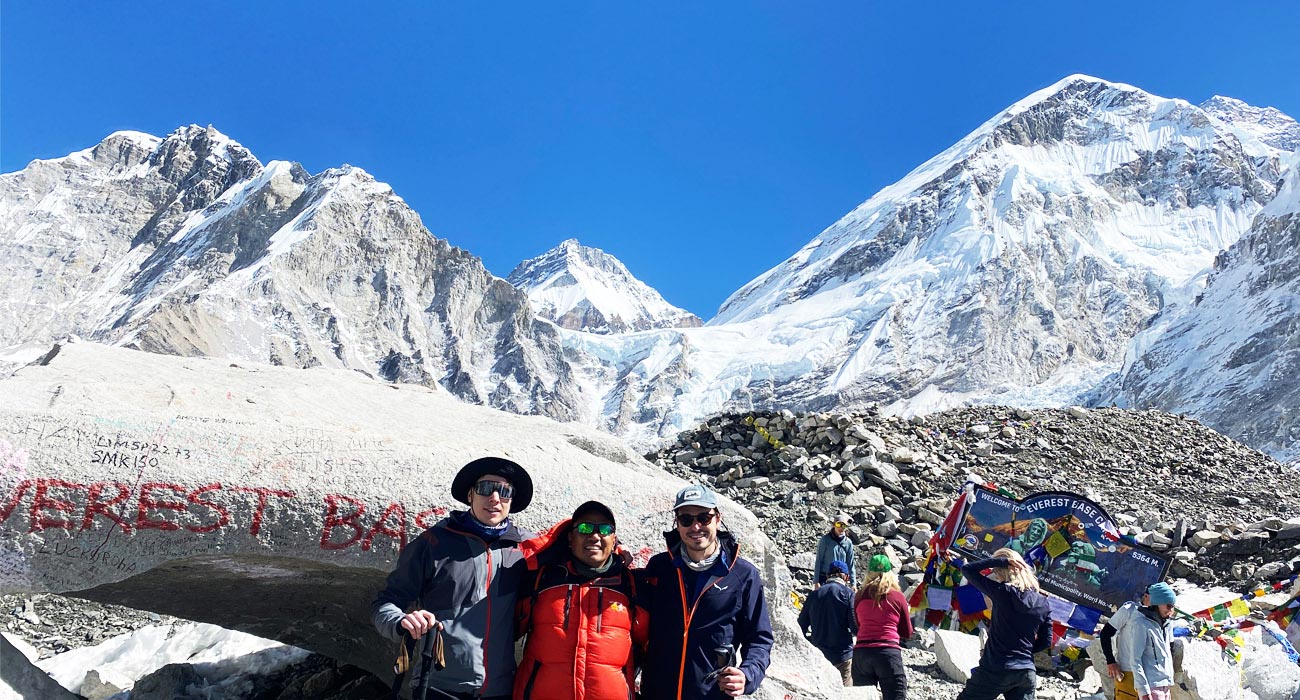
And then you're there. Base Camp, 5,364 m, the Khumbu Icefall rearing up in jagged blue-white blocks ahead of you. Photos never quite capture it - but standing there in person, with the glacier creaking and groaning around you, is a completely different thing.
Mornings at Gorak Shep are brutal - well below freezing, and the pre-dawn climb up Kala Patthar in the dark doesn't help. But the payoff is one of the best views in the entire Himalayas: Everest's summit, fully visible at last, turning orange as the sun rises over Nuptse and Lhotse.
After that cold start, the long walk back down through Gorak Shep and into Pheriche feels like a gift - thicker air, warmer temperatures, and a wide-open valley after days of tight, rocky trail.
Base Camp and Kala Patthar are behind you now, so today's mostly about mileage. You'll retrace the route back through Tengboche, and the forest that felt so unremarkable on the way up suddenly feels lush after days of bare rock. People tend to loosen up on this stretch too - tired, sure, but relaxed, swapping stories from the days spent up high. Rolling back into Namche after the quiet of the high villages feels almost like hitting a city.
The last full day follows the Dudh Koshi back down through villages that'll feel familiar from Day 1 and Day 2 - though everything looks a little different heading the other way. It's long, but easy compared to what you've just done, and most groups roll into Lukla with enough energy left for a proper celebration - drinks, group photos, the works, with the guides and porters who got you here.
The flight home depends a lot on the weather and time of year - sometimes it's a straight shot from Lukla, other times you're routing through Ramechhap with a few extra hours on the road. Either way, you get one last look at the mountains from above before Kathmandu's traffic and noise swallow you back up. After ten days in the Khumbu, that contrast hits hard - in the best way. It's proof of just how far you've actually come.
Service Types
Compare the available package types and choose the service level that matches your comfort, budget, and support needs.
Standard Package Cost
US$ 1580 per person
International Travel & Visa: International airfare and Nepal tourist visa fee.
Kathmandu Meals: Lunch and dinner before and after the trek.
Drinks & Extras: Tea, coffee, hot water, soft drinks, alcohol, and extra snacks.
Personal Expenses: Laundry, Wi-Fi, hot showers, charging, calls, and personal items.
Travel Insurance: High-altitude trekking insurance with emergency evacuation (up to 5,000m).
Personal Gear: Personal clothing, footwear, and trekking equipment.
Extra Costs: Expenses due to delays, itinerary changes, weather, illness, or unforeseen events.
Tips: Gratuities for guides, porters, and staff (highly appreciated).
Budget Package Cost
US$ 1250 per person
Airport Transfers: Private pick-up and drop-off at all international and domestic airports in Nepal.
Ground Transportation: Shared transportation between Kathmandu–Ramechhap–Kathmandu for domestic flight connections.
Domestic Flights: Round-trip Kathmandu–Lukla flights (direct or via Ramechhap, depending on season).
Trek Accommodation: 9 nights in clean, comfortable mountain teahouses during the trek.
Meals on Trek: Breakfast, lunch, and dinner throughout the trek.
Trekking Team: Experienced, licensed guide, with all their expenses included.
Permits & Taxes: All required trekking permits, government taxes, local fees, and VAT.
Health & Safety: First-aid kit, oximeter, and emergency rescue support (covered by travel insurance).
Communication: Free local SIM card provided by Mountain Eco Treks.
Special Services: Trek completion certificate,Traditional Nepali farewell dinner in Kathmandu
International Travel & Visa: International airfare and Nepal tourist visa fees.
Kathmandu Meals & Accommodation: Meals and lodging in Kathmandu are not included.
Drinks & Extras: Tea, coffee, hot water, hot showers, soft drinks, alcohol, snacks, Wi-Fi, electricity charges, laundry, and personal items.
Travel Insurance: High-altitude trekking insurance with emergency evacuation (up to 5,000m).
Personal Gear: Clothing, footwear, and personal trekking equipment.
Porter Service: Available on request at an additional cost.
Extra Costs: Expenses due to delays, itinerary changes, weather, illness, or unforeseen events.
Tips: Gratuities for guides and porters are recommended.
The Everest Base Camp short trek is a condensed version of the classic EBC trek in Nepal. It follows the route through Lukla, Namche Bazaar, Dingboche, and Gorak Shep to Everest Base Camp, with fewer or no dedicated acclimatization days. This itinerary is more suitable for experienced trekkers who are comfortable with high-altitude trekking and a faster pace.
Yes, when properly planned. The biggest concern is altitude, so choose an itinerary with appropriate acclimatization and follow your guide's advice if you develop altitude symptoms.
The cost varies by season, group size, services, and whether helicopter transportation is included. Always check what is included, such as permits, guide, accommodation, meals, flights, and transfers.
A typical package may include permits, a licensed guide, accommodation, meals, regional flights, and airport transfers. Helicopter flights, travel insurance, personal equipment, and tips may be extra.
You generally need the Sagarmatha National Park entry permit and Khumbu Pasang Lhamu Rural Municipality permit or fee. Your trekking agency can arrange the required permits and confirm current regulations.
A licensed guide is strongly recommended for the Everest Base Camp trek and is particularly valuable on a short itinerary. A guide can assist with navigation, acclimatization, logistics, and emergencies.
Everest Base Camp is approximately 5,364 metres (17,598 feet) above sea level. Kala Patthar, a popular viewpoint, Kalapatther is higher at approximately 5,545 metres.
Most trekking days involve approximately 5–8 hours of walking, depending on the route, altitude, and pace. The higher-altitude days can feel considerably more demanding.
Do not continue ascending if altitude symptoms are getting worse. Inform your guide immediately; serious symptoms may require immediate descent and medical assistance.
Yes. Many short EBC packages offer a helicopter return from the upper Khumbu region to Kathmandu. Flights depend on weather, visibility, landing conditions, and availability.
Not always. Helicopter pickups may operate from Gorak Shep or another suitable landing area, depending on conditions and the operator's arrangements.
Your trekking company will normally try to arrange the next available flight. A helicopter may be an alternative when weather and availability permit, usually at an additional cost.
Keeping 1–2 extra days in your Nepal itinerary is recommended because Lukla flights can be affected by weather. Extra days are especially useful if you have a fixed international flight after the trek.
The most popular seasons are spring (March–May) and autumn (September–November). These months generally offer favorable trekking conditions and good mountain visibility.
The summit of Everest is not clearly visible from Base Camp itself because surrounding mountains block the view. Kala Patthar is one of the best places for panoramic Everest views.
Yes, especially if you have limited vacation time. A well-planned short trek lets you reach Everest Base Camp in less time, while a standard itinerary provides a slower pace and more flexibility.
Mountain Eco Treks can help arrange your Everest Base Camp short trek, including trekking logistics, permits, accommodation, guides, flights, and optional helicopter transportation. Choose an itinerary based on acclimatization, safety, and overall experience-not just the shortest number of days.
Mountain Eco Treks is a licensed local Nepal trekking company based in Kathmandu, founded by Ram Bahadur Tamang, a mountain leader with more than 15 years of trekking and expedition experience across Nepal and Tibet. Registered with the Nepal Tourism Board (NTB) and TAAN, we provide reliable trekking services with a strong focus on safety, local expertise, and responsible tourism.
We operate as a fully registered trekking company in Nepal with transparent services and recognized tourism affiliations.